Average Face Meaning: Why Normal Faces Can Still Be Attractive
A practical guide to average faces, normal face ratings, photo effects, and why typical features are not a negative result.

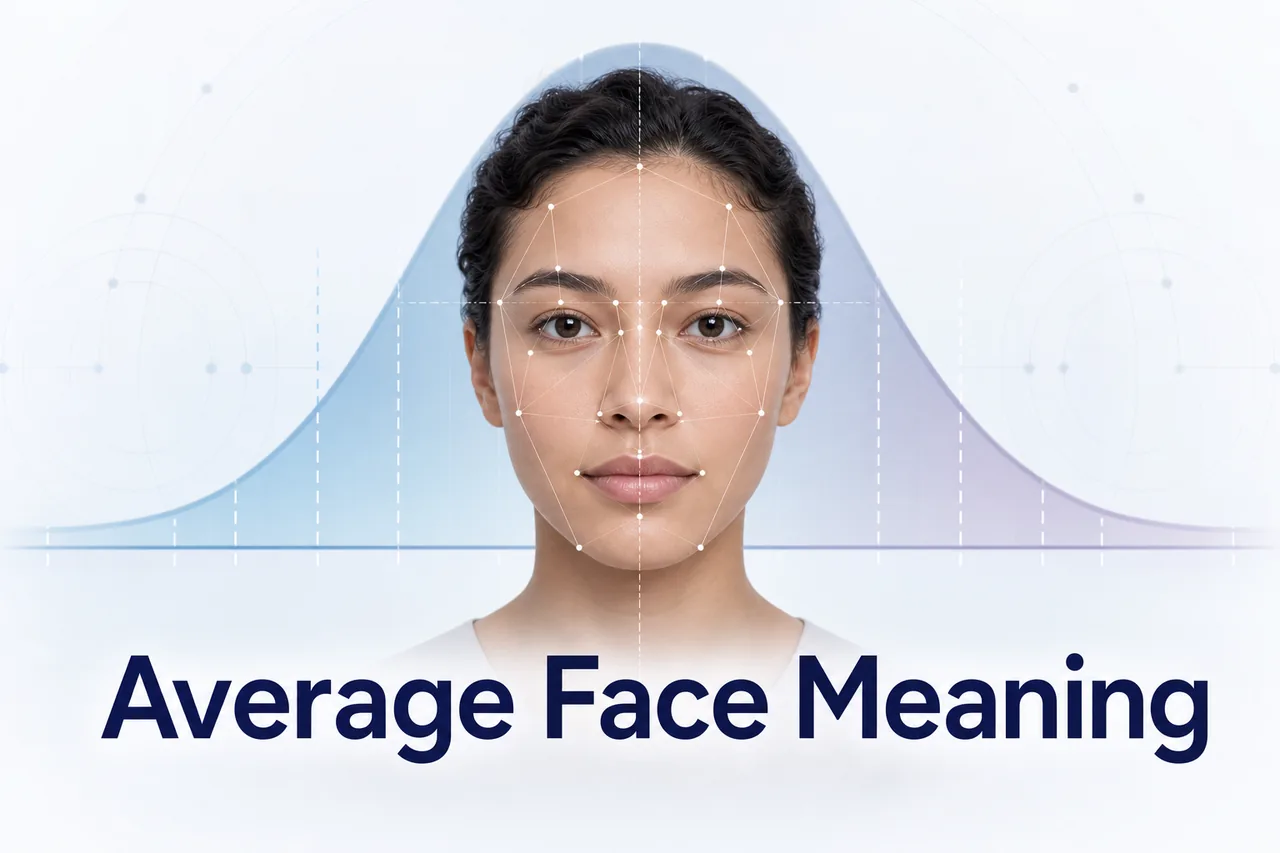
Table of Contents
- What Does Average Face Mean?
- Normal Face vs Attractive Face
- Average Face Examples
- Why Average Faces Often Score Well
- How AI Reads Facial Normality
- How Average Am I? Reading Your Result
- Where Average, Normal, and Distinctive Results Fit
- Why Photos Change Your Normal Face Rating
- When Normal Is Not the Whole Goal
- How to Use AI Face Results
- FAQ
If you searched for average face meaning, normal face, or how average am I, you are probably trying to understand what an AI face test is really saying. The short version is simple: average does not mean unattractive. It means your visible facial measurements are close to patterns that appear often across many faces.
That distinction matters because words like normal and average can feel personal. In everyday language, average can sound like a disappointing result. In facial analysis, however, average is often a technical idea. It describes symmetry, proportions, spacing, and other measurable patterns in a photo.
This guide explains what average face means, how a normal face rating differs from an attractiveness score, why average faces can be perceived as appealing, and how to read your How Normal Am I result without treating one AI output as a final verdict.
What Does Average Face Mean?
An average face is not a single universal face. It is a statistical idea: a face whose visible measurements sit near the middle of a reference group. Those measurements can include eye spacing, face length-to-width ratio, nose-to-face proportion, lip width, jaw outline, and left-right symmetry.
When researchers or AI systems discuss averageness, they are usually talking about how close a face is to common population patterns. A face can be average in one dimension and distinctive in another. For example, someone might have very typical eye spacing but a more distinctive jawline, nose shape, or smile.
In an AI face test, average face AI analysis usually starts from the uploaded photo. That means the system is reading the image conditions as well as the face. Camera angle, lens distortion, shadows, expression, makeup, facial hair, and hair covering the face can all change how average or normal the image appears.
Key Point
Average face meaning is about statistical closeness to common visual patterns. It is not a statement that your face is plain, unattractive, or forgettable.
Normal Face vs Attractive Face
A normal face rating and an attractiveness score overlap, but they are not identical. A normal face score asks how typical the visible structure looks. An attractiveness score usually adds other factors such as harmony, clarity, symmetry, and model-specific preferences.
| Concept | What It Usually Measures | How to Interpret It |
|---|---|---|
| Average face | Closeness to common facial proportions and feature spacing | Typical or familiar, not automatically unattractive |
| Normal face | Whether the visible face falls near expected population ranges | A technical comparison, not a moral or personal label |
| Attractive face | A mix of symmetry, proportion, clarity, harmony, presentation, and preference | Can be average, distinctive, or somewhere in between |
| AI face score | The model's estimate from one uploaded image | Useful for photo feedback, limited as a life judgment |
This is why a very normal face can still score well on a face test. Many people perceive familiar, balanced, easy-to-process faces as attractive. A face does not need extreme features to be appealing.
The reverse is also true: a distinctive face can be attractive even if it is less average. Some faces stand out because of strong cheekbones, expressive eyes, unusual proportions, or memorable styling. AI tools can notice some of that, but they rarely capture the full effect of presence, motion, confidence, and personality.
Average Face Examples: What the Term Usually Means
Average face does not mean every feature is plain. It usually means the overall structure sits near common ranges while individual traits may still be memorable.
Average spacing, distinctive shape
Eye spacing or face width may be common while your jaw, brows, lips, or smile still feel distinctive.
Balanced photo, stable score
A centered, well-lit photo often makes the face look more average because the AI can read landmarks cleanly.
Average does not mean invisible
Many attractive faces are built from familiar proportions plus expression, styling, and confidence.
Distinctive does not mean wrong
A feature outside the average range can be memorable or attractive; the AI score is not the whole story.
This is why the best interpretation is specific: ask which part of the face is average, which part is distinctive, and whether photo conditions made the face look more or less typical.
See how country-level composite portraits are created—and why they cannot define individuals. Average faces by country
Why Average Faces Often Score Well
Average faces often score better than users expect because facial averageness is linked with visual fluency. In simple terms, the brain tends to process familiar patterns quickly. A face close to common proportions can feel balanced, approachable, and easy to read.
Classic attractiveness research has often discussed three recurring ideas: averageness, symmetry, and sexual dimorphism. Averageness does not mean every individual feature is ordinary. It means the overall configuration is close to patterns people have seen many times before.
For AI face analysis, this matters because many models reward stable geometry. A centered photo with clear landmarks, balanced lighting, and common proportions may produce a solid result even when the user expected average to mean mediocre.
Research Context
Academic discussions of facial attractiveness often treat averageness as one important factor among several, alongside symmetry, proportion, and cultural context. For a neutral overview, see the Averageness overview.
How AI Reads Facial Normality
A How Normal Am I style test does not understand your identity or real-life appeal. It reads visible patterns from an image. Most systems estimate normality through groups of measurable signals.
Feature Spacing
The AI compares distances between visible landmarks, such as eye spacing, nose width, mouth width, and their relationship to total face width.
Facial Proportions
The model checks whether the face length, width, vertical thirds, and feature sizes fall near common ranges for the dataset or scoring logic.
Symmetry
Left-right balance can affect both normal face ratings and attractiveness scores, especially when the photo is straight-on and evenly lit.
Photo Quality
Sharpness, shadows, lens angle, occlusion, and facial expression can change what the AI sees, even when the underlying face has not changed.
Because the test is image-based, it is best to treat the output as a reading of one photo. A stable interpretation comes from testing several clear, similar photos and looking at the range instead of reacting to one number.
How Average Am I? Reading Your Result
If your result says you are average, normal, typical, or close to the mean, the most useful response is not panic. Ask what the score is measuring and how reliable the input photo was.
Normal Face Rating Interpretation
| Result Pattern | Possible Meaning | Best Next Step |
|---|---|---|
| Close to average | Common proportions, stable landmarks, balanced visible geometry | Treat it as a solid baseline, not a negative label |
| More distinctive | Some measurements differ from common ranges or the photo exaggerates them | Check if angle, lens distance, or expression affected the result |
| High attractiveness with average traits | The face may combine familiar proportions with strong harmony or clarity | Compare several similar photos to confirm stability |
| Low score from one photo | Often caused by shadows, tilt, blur, occlusion, or detection issues | Retake the photo before interpreting the score |
A mid-range result often means the AI found no extreme deviations in the photo. That can be a perfectly good outcome. It may suggest that your proportions are common, balanced, and easy for the model to detect.
A very high or very low normality result deserves context. A high score may reflect excellent photo conditions and balanced geometry. A low score may reflect a tilted head, harsh lighting, partial occlusion, or landmark detection trouble rather than your actual face.
Check your own range
The fastest next step is to upload a clear selfie to the how average am I photo test and compare several similar photos instead of reacting to one number.
Where Average, Normal, and Distinctive Results Fit
Average face meaning is easier to use when you separate three ideas: average, normal, and distinctive. They can overlap, but they do not point to the same next step.
| Result word | Best interpretation | Best next step |
|---|---|---|
| Average | Close to common visual proportions or spacing | Check photo conditions and treat it as a baseline |
| Normal | Within expected visible ranges for the model | Do not read it as plain or unattractive; compare photos |
| Distinctive | Some traits stand away from the average pattern | Check whether angle, lens, or expression exaggerated it |
This keeps the page focused on interpretation. Upload-photo intent belongs on the home test, while 1-10 score interpretation belongs on the score guide.
Why Photos Change Your Normal Face Rating
People often ask why they look normal in one photo but less normal in another. The reason is that AI face tests score the image, not a perfect abstract version of your face.
-
Camera distance can distort proportions
A very close selfie can enlarge the nose and compress the sides of the face. Step back slightly and use a normal lens distance for a more balanced reading. -
Head tilt changes symmetry
Even a small tilt can make one eye appear higher, one cheek more prominent, or the jawline less balanced. Face the camera directly for a fairer normal face score. -
Lighting changes facial landmarks
Hard shadows can hide the eye area, nose edge, or jaw contour. Soft front lighting gives the AI more reliable information. -
Expression shifts facial geometry
A wide smile, squint, or raised eyebrow changes proportions temporarily. A relaxed expression usually gives a cleaner baseline. -
Hair, glasses, and filters can confuse the model
Anything that covers landmarks or changes texture can make an average face AI result less stable.
Best Practice
Use three clear front-facing photos in similar lighting. If the results cluster near the same range, that range is more useful than any single upload.
When Normal Is Not the Whole Goal
Normality is only one lens. Some attractive faces are memorable because they are not perfectly average. Distinctive features, expressive styling, confidence, and movement all matter in real life.
AI tools are strongest when they compare visible, repeatable patterns in photos. They are weaker at reading warmth, charisma, posture, voice, humor, social fit, and cultural preference. Those factors often change how attractive someone feels in person.
So if your result is average, do not treat that as a ceiling. If your result is distinctive, do not treat that as a flaw. Both average and distinctive faces can be attractive for different reasons.
How to Use AI Face Results Without Overthinking Them
The healthiest way to use a normal face rating is as photo feedback, not identity feedback. The result can help you understand what the camera and model are seeing, but it should not replace human judgment.
- Use the score to compare photo quality, not personal value.
- Retest with better lighting before drawing conclusions.
- Read score bands together with the explanation, not as a bare number.
- Remember that average face meaning is statistical, not emotional.
- Use related guides, such as the How Normal Am I score explanation, when you want to understand the full 1-10 rating.
If you want a practical next step, upload a clear photo, note the result, then test one or two similar photos. Consistent results are more meaningful than a dramatic one-off score.
Want to See Your Normal Face Rating?
Upload a clear selfie and compare your result with the explanation above. The test works best with front-facing photos in soft light.
Take the How Normal Am I TestAverage Face Meaning FAQ
About the Author
Sarah Mitchell
Beauty tech journalist · 8+ years covering AI and aesthetics
Sarah writes about AI face analysis, beauty technology, and the limits of automated appearance scoring. Her work focuses on helping everyday users understand what facial analysis tools can measure, what they cannot measure, and how to interpret results without overreacting to a single number.
References & Further Reading
- Langlois, J. H., & Roggman, L. A. (1990). Attractive faces are only average. Psychological Science, 1(2), 115-121.
- Rhodes, G. (2006). The evolutionary psychology of facial beauty. Annual Review of Psychology, 57, 199-226. - PubMed
- Averageness overview and examples of composite-face research. - Wikipedia
- How Normal Am I Score Explained: a related guide to interpreting the 1-10 face rating. - Score guide
Last updated: 2026-07-04