ChatGPT Attractiveness Test: What AI Can Tell You About a Photo
A practical guide to ChatGPT face ratings, dedicated AI attractiveness tests, photo quality, privacy, and the limits of any beauty score.
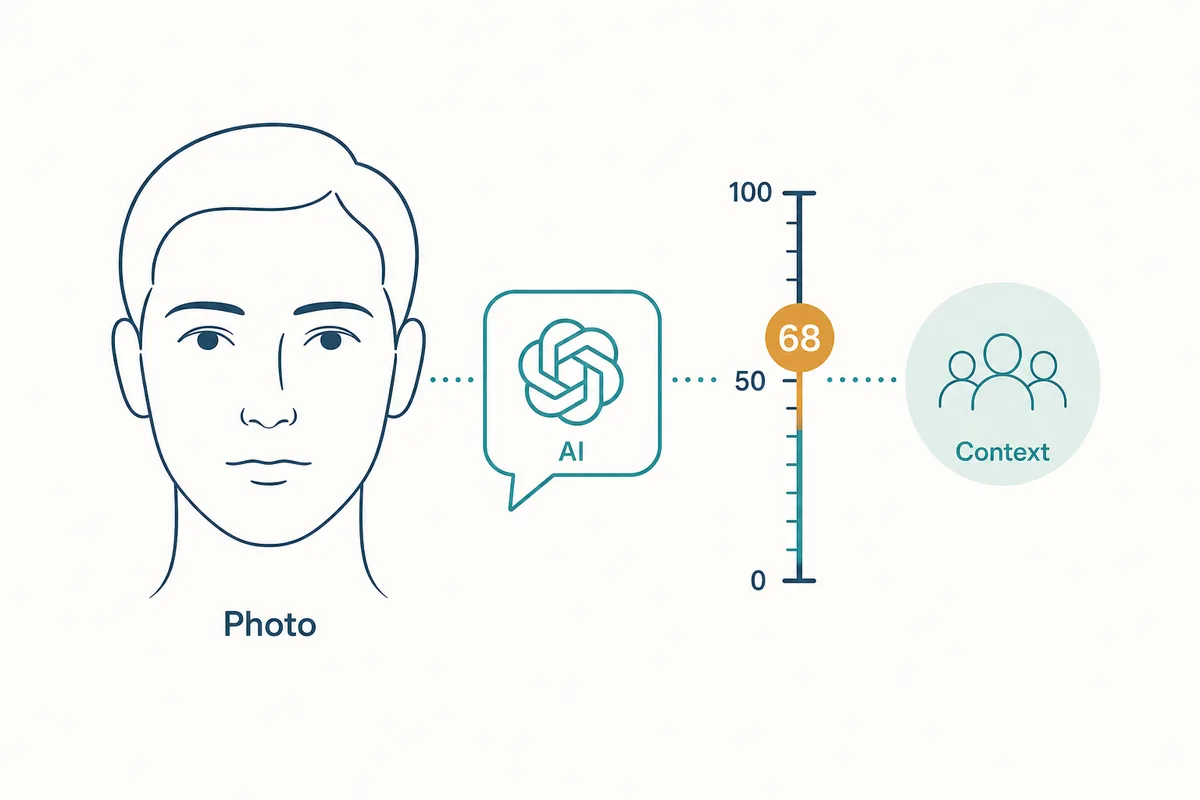
Table of Contents
Search interest around the ChatGPT attractiveness test has grown because people want a fast, private way to ask: am I attractive, do I look normal, or why does this selfie feel different from real life? The question is understandable, but the answer depends heavily on the tool you use and the photo you upload.
ChatGPT can discuss visible patterns in an image when image input is available: lighting, pose, expression, grooming, composition, and general presentation. A dedicated AI face rater is narrower. It estimates landmarks, symmetry, proportions, and photo-specific facial harmony. Those are different jobs, and mixing them up leads to overconfident conclusions.
This guide explains where a ChatGPT face rater prompt can help, where it becomes unreliable, and how to combine an AI attractiveness test with common sense. The goal is not to chase a perfect score. The goal is to understand what one photo communicates and what it cannot possibly prove.
Should You Use ChatGPT for an Attractiveness Test?
You can use ChatGPT as a reflective photo coach, but it is not a universal beauty judge. It can describe why a photo may read as friendly, tired, polished, harsh, symmetrical, soft, or high contrast. It can also help you rewrite the question from a loaded personal judgment into a smaller, safer one: what is working in this picture, and what could I improve next time?
That distinction matters. A prompt like rate my face can invite a false sense of precision. A better prompt asks for observable factors: lighting, camera angle, expression, framing, grooming, and whether the photo is suitable for an AI face rating. When the question is about a number, a dedicated photo-based tool is usually more consistent. When the question is about interpretation, ChatGPT can be useful.
Good use
Ask for photo quality feedback, expression notes, and ways to make a fairer comparison.
Risky use
Treating one generated opinion as proof of attractiveness, social value, or identity.
ChatGPT vs a Dedicated AI Face Rater
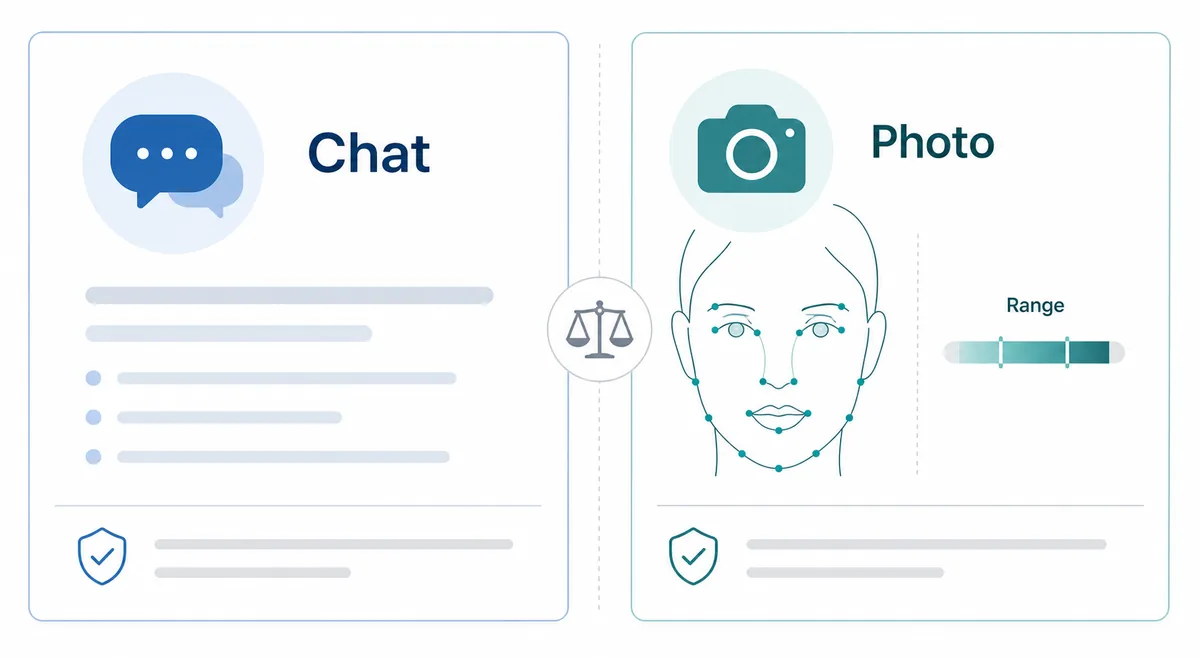
A ChatGPT attractiveness test and an AI face rater can overlap, but they should not be evaluated as if they produce the same evidence. ChatGPT is strong at language, explanation, context, and caution. A face rater is better suited to repeatable photo measurements when the uploaded image is clear enough.
Use the comparison below before deciding whether a keyword like chatgpt face rater needs a tool, a guide, or both. In most cases, readers benefit from the guide first, then a link to a focused photo test.
| Question | ChatGPT is useful for | AI face rater is useful for |
|---|---|---|
| Why does this selfie look different? | Explaining lighting, lens, pose, expression, and framing | Checking whether the same photo produces a stable score |
| Am I attractive in this photo? | Giving cautious, qualitative feedback | Estimating a photo-based attractiveness score |
| How normal is my face? | Clarifying what normal can and cannot mean | Comparing visible geometry with common facial patterns |
| What should I change? | Suggesting better photo setup and presentation | Showing whether the next test changes after photo quality improves |
How to Run a Fair ChatGPT or AI Attractiveness Test
Most disappointing AI ratings are not really about the face. They are about a poor input image. Strong backlight, a wide phone lens, a tilted head, heavy filters, or an exaggerated expression can move the result more than any real feature difference.
Before comparing numbers, make the photo boring in a good way: clear, front-facing, evenly lit, and close to how you normally look. Then test a small set of similar photos instead of one dramatic image.
-
Use soft front light
Face a window or a diffuse light source so shadows do not change feature shape. -
Keep the camera level
Hold the lens near eye height and avoid extreme close-up distortion. -
Use a neutral expression
A relaxed mouth and open eyes make landmark detection more stable. -
Avoid filters and heavy edits
Beauty filters can change skin texture, jawline, eye size, and proportions. -
Compare a range
Run two or three similar photos and look for a pattern rather than obsessing over one score.
How to Read an Attractiveness Score Without Overreacting
A score is a label on one image, not a verdict on a person. The most useful interpretation is comparative: did the result stay similar across well-lit photos, did a better angle improve the score, and did the tool identify consistent strengths or weak photo conditions?
Do not treat small score differences as meaningful. A change from 6.7 to 7.1 may simply reflect light, cropping, or expression. A larger repeated pattern across several fair photos is more informative, but still limited to visible appearance in images.
Look for patterns
Use score ranges and repeated notes, not a single number.
Keep identity separate
The result can describe a photo. It cannot define confidence, warmth, charisma, or worth.
Privacy and Safety Questions to Ask First
Any face-rating workflow starts with a personal photo, so privacy matters. Read the tool's privacy language, avoid uploading images of other people without consent, and do not include sensitive background details, documents, school badges, addresses, or children in the frame.
If you use ChatGPT or any image-capable AI assistant, remember that product settings and data controls can vary by account, region, and plan. Use official help pages for current details. For casual appearance curiosity, choose the least sensitive photo that still answers the question.
Use low-risk images
Crop out background details and avoid photos that reveal location, workplace, or private information.
Do not test others secretly
Face ratings are personal. Use your own photo or get clear permission.
When You Should Not Use AI Face Ratings
Do not use a ChatGPT attractiveness test when the question feels urgent, painful, repetitive, or tied to self-worth. Retesting can become a loop: one number feels bad, another number feels temporarily better, and neither answers the deeper concern.
AI tools also cannot diagnose body dysmorphia, anxiety, depression, social rejection, health conditions, or whether someone will like you in real life. If appearance questions are causing distress or interfering with daily life, a trusted person or qualified professional is a better next step than another rating.
Try a photo-based AI attractiveness test
Use a clear selfie, read the result as a photo signal, then compare it with the guidance above instead of treating it as a personal verdict.
Test Your PhotoFAQ
About the author
Sarah Mitchell
Beauty tech journalist · 8+ years covering AI and aesthetics
Sarah writes about AI face analysis, beauty technology, and the limits of automated appearance scoring. Her work focuses on helping everyday users understand what facial analysis tools can measure, what they cannot measure, and how to interpret results without overreacting to one number.
References
- OpenAI Help Center - ChatGPT Image Inputs FAQ
- OpenAI Help Center - Data Controls FAQ
- Google Search Central - Helpful content guidance
Last updated: 2026-07-02
Back to Home