Face Symmetry Test Guide: How to Check Facial Symmetry Without Overreading It
A practical guide to face symmetry tests, online photo checks, asymmetrical face results, photo mistakes, and how symmetry affects AI attractiveness scores.

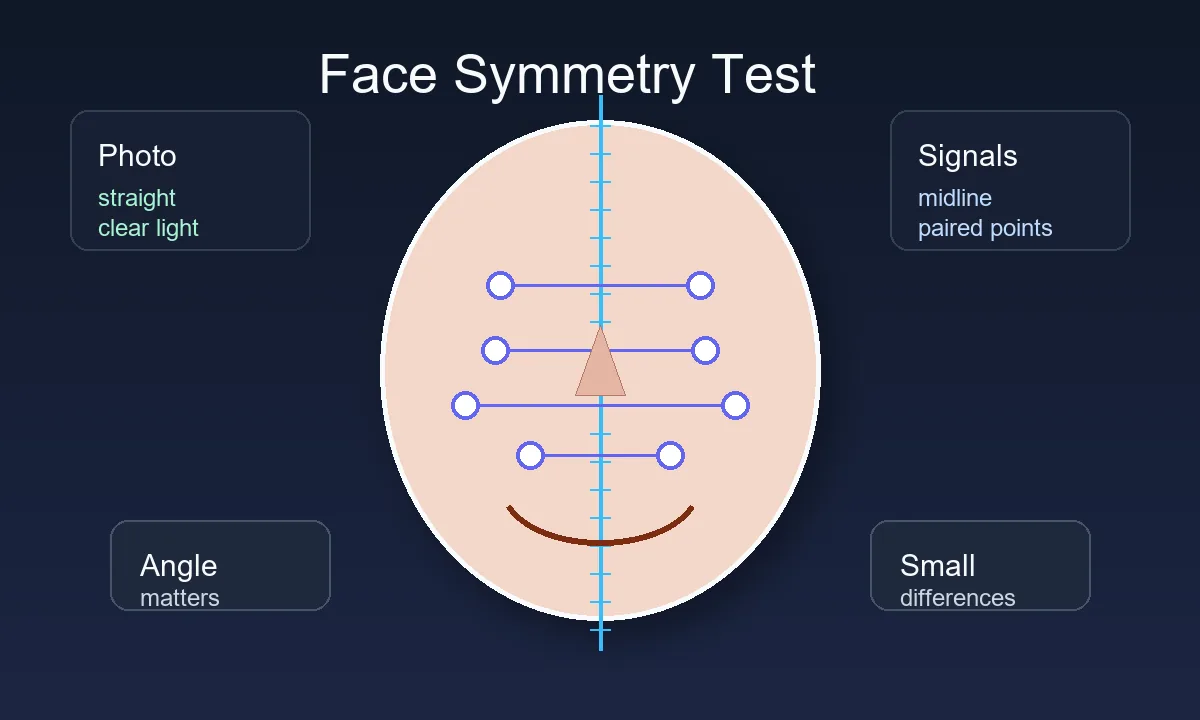
Table of Contents
If you searched for face symmetry test, facial symmetry test, or how symmetrical is my face, you are probably trying to understand whether a photo shows balanced facial features. The useful answer is more nuanced than a single percentage. Symmetry can influence how a face is perceived, but small differences between the left and right side are part of normal human variation.
AI tools usually estimate symmetry from visible landmarks: eye corners, pupils, nostrils, mouth corners, jaw outline, brow height, and the vertical midline of the face. Those landmarks are strongly affected by camera angle, head tilt, lighting, expression, hair, glasses, and lens distance.
This guide explains what a face symmetry test can measure, how to take a better photo, how to interpret an asymmetrical face result, and when sudden or severe facial asymmetry should be treated as a health signal rather than a beauty score.
What Does a Face Symmetry Test Actually Measure?
A face symmetry test compares paired landmarks on the left and right side of the face. In a front-facing photo, the model estimates a center line and checks whether matching points sit at similar distances, heights, and angles from that line.
Common measurements include eye height, eye spacing, eyebrow position, nostril width, cheek contour, mouth-corner height, chin alignment, and jaw balance. A strong result does not mean both sides are identical. It usually means the visible landmarks are balanced enough for the model to read them as stable.
The test is not a medical scan, a diagnosis, or a perfect map of your bone structure. It is an image-based estimate. A tilted selfie can make a symmetrical face look uneven, while a carefully centered photo can make ordinary asymmetry look smaller.
| Signal | What the AI compares | What can distort it |
|---|---|---|
| Eye and brow level | Whether paired eye and brow landmarks sit at similar heights | Head tilt, squinting, uneven light, glasses |
| Nose and mouth center | Whether the nose bridge, philtrum, and mouth align near the face midline | Camera angle, smile, lens distortion |
| Jaw and cheek balance | Whether cheek and jaw contours appear similar on both sides | Hair, shadows, posture, wide-angle selfies |
| Overall landmark clarity | Whether the model can detect enough reliable points | Blur, low resolution, filters, occlusion |
How to Check Facial Symmetry With an Online Face Symmetry Test
The fairest way to use an online face symmetry test is to control the photo first. Most surprising results come from image setup, not from the face itself. Treat the test like a small measurement experiment: keep the input clean, then compare a few similar shots.
You do not need a studio. You need a straight camera, soft light, a relaxed expression, and an uncovered face. The goal is to help the AI find landmarks instead of asking it to guess through shadows or perspective distortion.
Best practice
Use the same photo setup when comparing results. Changing angle, lens distance, and lighting turns the test into a camera-quality comparison.
-
Face the camera directly
Keep both ears or both sides of the jaw equally visible. A slight turn can shift the nose, mouth, and cheek line enough to affect the score. -
Hold the camera farther back
Very close selfies exaggerate the nose and compress the sides of the face. Step back and crop later if needed. -
Use soft front lighting
Avoid hard side shadows. Even light makes the eye area, nose edge, lips, and jaw easier to detect. -
Relax your expression
A wide smile, raised eyebrow, or squint can temporarily change symmetry. Use a neutral or gentle expression for a baseline. -
Test more than one photo
If three clear photos give similar symmetry feedback, the pattern is more meaningful than one outlier result.
How Much Facial Asymmetry Is Normal?
Some facial asymmetry is normal. Human faces are not perfectly mirrored objects. One eye may sit slightly higher, one cheek may be fuller, one brow may move more, or one side of the smile may lift differently. These small differences often become more visible in still photos than in real life.
The phrase asymmetrical face can sound negative, but it usually describes ordinary variation. A face can be asymmetrical and still attractive, expressive, memorable, and photogenic. Symmetry is one signal among many, not the whole story.
Research on facial attractiveness often discusses symmetry together with averageness and proportion. That does not mean perfect symmetry is required. In fact, perfectly mirrored faces can sometimes look unusual because real faces normally contain small, natural differences.
Interpretation rule
Small left-right differences are expected. Focus on whether the asymmetry is sudden, extreme, or changing, not whether a tool finds any difference at all.
Why Online Face Symmetry Test Results Change Between Photos
A face symmetry photo test reads pixels, so two photos of the same person can produce different results. This is especially true for wide-angle phone selfies, low light, and photos taken slightly from above or below.
A lower symmetry score from one image often means the model struggled with landmarks. It may be reacting to a shadow under one eye, hair covering one cheek, a tilted head, a smile pulling one side of the mouth, or one lens of glasses reflecting light.
- Close selfies can enlarge central features and make side contours look uneven.
- Side lighting can hide one cheek or one nostril edge.
- A raised shoulder or tilted neck can rotate the jawline.
- Filters and beauty modes can move texture and edge details unpredictably.
- A single frozen expression can exaggerate an asymmetry that is barely noticeable in motion.
How Symmetry Affects AI Attractiveness and Normal Face Scores
Symmetry can influence both attractiveness scores and normal face ratings because it gives the model a clean geometric signal. Balanced left-right landmarks are easier to compare with reference patterns, especially when the photo is sharp and centered.
That does not mean symmetry equals beauty. A face score can also reflect feature spacing, facial proportions, averageness, skin clarity visible in the image, expression, and the model-specific training data. A distinctive face may score well even with visible asymmetry, and a highly symmetrical image may still feel less expressive in real life.
For a practical reading, combine this symmetry guide with the How Normal Am I score explanation and the average face guide. Together they separate three related ideas: left-right balance, statistical normality, and perceived attractiveness.
| Result pattern | Likely meaning | Best response |
|---|---|---|
| High symmetry across several photos | The face is consistently easy for the model to align | Treat it as a stable geometric signal |
| Low score in one selfie only | Photo angle, expression, or lighting probably distorted landmarks | Retake the photo before interpreting it |
| Mild asymmetry in every photo | Normal human variation or a distinctive feature pattern | Do not overread it as a flaw |
| Sudden new asymmetry | Potential health signal rather than cosmetic feedback | Seek medical advice, especially with weakness, speech trouble, or facial drooping |
When Facial Asymmetry Needs Medical Attention
Most asymmetry noticed in selfies is harmless. However, sudden facial drooping, new weakness on one side, trouble speaking, confusion, severe headache, or one-sided numbness should not be treated as an AI beauty-test issue.
Public health guidance for stroke warning signs often uses face drooping as one part of FAST: face, arms, speech, and time. If facial asymmetry appears suddenly with those symptoms, seek urgent medical help immediately.
For long-standing asymmetry, jaw pain, injury, dental bite changes, or progressive changes, a clinician, dentist, or specialist can give context that an online face symmetry test cannot provide.
Health note
This article is informational and not medical advice. Sudden facial drooping or weakness is urgent and should not be evaluated with a cosmetic scoring tool.
Check Your Photo With How Normal Am I
Upload a clear front-facing selfie to see how the AI reads your face geometry, normality, and attractiveness score.
Take the AI Face TestFace Symmetry Test FAQ
References & Further Reading
- Perrett, D. I., Burt, D. M., Penton-Voak, I. S., Lee, K. J., Rowland, D. A., & Edwards, R. (1999). Symmetry and human facial attractiveness. Evolution and Human Behavior, 20(5), 295-307. - ScienceDirect
- Rhodes, G. (2006). The evolutionary psychology of facial beauty. Annual Review of Psychology, 57, 199-226. - PubMed
- CDC FAST warning signs for sudden facial drooping and stroke symptoms. - CDC
Related Guides
How Normal Am I Score Explained
Understand how the 1-10 AI score should be read and why one photo is not a final verdict.
Read the score guideAverage Face Meaning
Learn how statistical normality differs from attractiveness and why average does not mean unattractive.
Read the average face guideFacial thirds guide
Measure the upper, middle, and lower face regions with a consistent front-facing photo.
Read the facial thirds guideLast updated: 2026-08-13
Back to Home