Facial Thirds: How to Measure and Read Face Proportions
A practical guide to the upper, middle, and lower thirds—without turning a classical guideline into a beauty verdict.

In this guide
Facial thirds are a simple way to describe vertical face proportions. Artists, photographers, orthodontic researchers, and aesthetic clinicians may use similar landmarks, but the measurement does not prove that a face is attractive, healthy, or “normal.”
The useful question is not whether all three numbers are identical. It is whether you measured a stable photo consistently and understand which region looks relatively longer or shorter.
What are facial thirds?
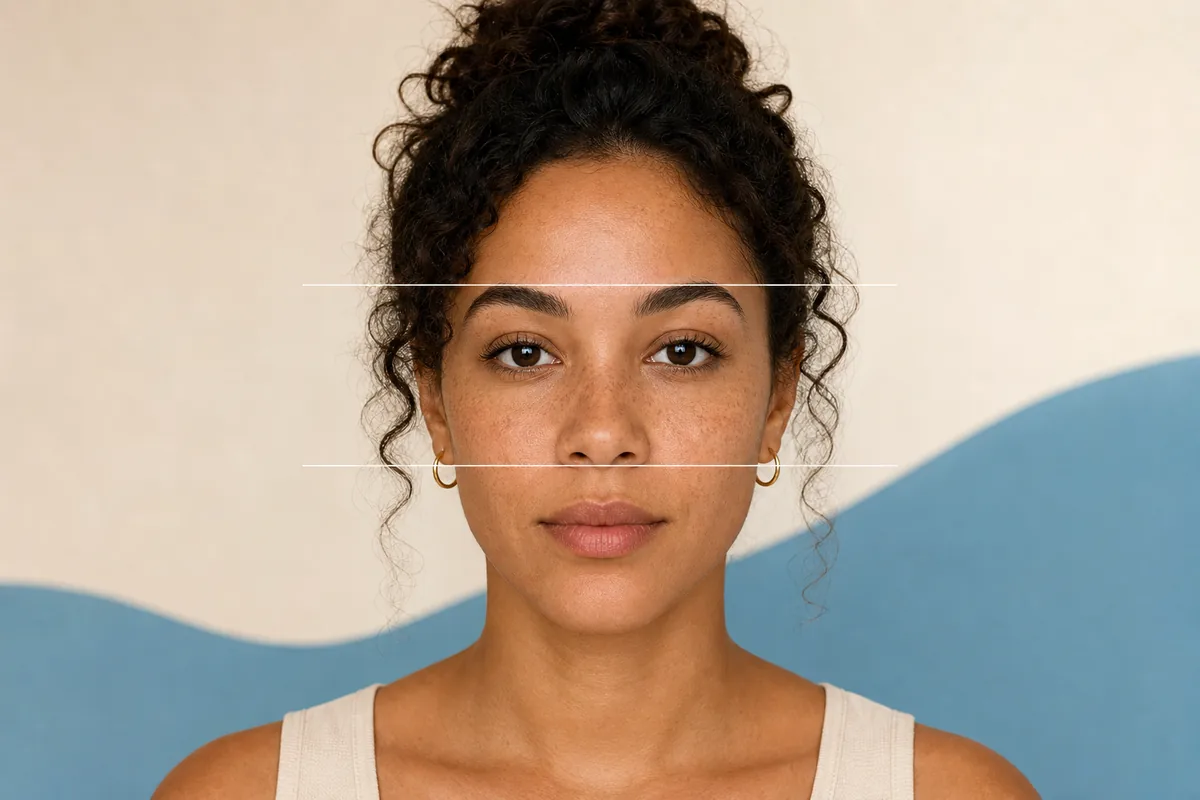
The classical horizontal thirds divide the face from the visible hairline to the brow or glabella area, from that level to the base of the nose, and from the nose base to the lowest point of the chin. Technical sources may call these landmarks trichion, glabella, subnasale, and menton.
“Equal facial thirds” is a reference canon, not a universal human average. Hairline shape, age, ancestry, sex-related variation, hairstyle, jaw growth, and camera perspective all affect visible proportions.
Use thirds as a map
A facial thirds test is most useful for describing where a difference appears—not for grading the whole face.
The three regions and their landmarks
Use the same landmark definition every time. The upper third is especially sensitive because a hidden, uneven, or receding hairline changes the starting point.
| Region | Approximate landmarks | What can change it |
|---|---|---|
| Upper third | Visible hairline to brow/glabella area | Hairline, hairstyle, forehead tilt |
| Middle third | Brow/glabella area to nose base | Head pitch, landmark choice, lens angle |
| Lower third | Nose base to bottom of chin | Expression, lip posture, jaw position |
Prepare a consistent photo before measuring
Use a front-facing photo taken at eye level. Keep the head upright, shoulders square, expression relaxed, lips resting naturally, and hair away from the visible hairline.
Move the camera farther away and use moderate zoom if available. A very close selfie can enlarge the center of the face and make the middle third look different. Repeat the photo before trusting a surprising result.

How to measure facial thirds step by step
You can measure in pixels, millimeters on a printout, or with a simple image editor. Ratios matter more than the physical unit.
-
Mark four points
Mark the visible hairline center, brow/glabella level, base of the nose, and lowest point of the chin. -
Draw three horizontal spans
Measure hairline-to-brow, brow-to-nose-base, and nose-base-to-chin along the same center line. -
Compare percentages
Add the three lengths, then divide each region by the total facial height. Roughly one third each is the classical reference. -
Repeat with a second photo
If the result changes a lot, fix the photo setup before interpreting your proportions.
How to read equal or unbalanced facial thirds
A longer upper third may reflect a higher visible hairline or landmark choice. A shorter middle third can come from head tilt or the selected brow point. A longer lower third may reflect chin height, lip posture, jaw structure, or camera angle.
Do not “correct” a difference based on one selfie. Compare two or three standardized images and describe the result neutrally: for example, “the lower third appears slightly longer in this photo.”
Difference is not defect
Natural faces vary. A proportion that differs from a classical canon is not automatically unattractive or abnormal.
Facial thirds vs. golden ratio, symmetry, and face shape
These ideas answer different questions and should not be collapsed into one score.
| Concept | Main question | Best use |
|---|---|---|
| Facial thirds | How is vertical face height distributed? | Describe upper, middle, and lower regions |
| Golden ratio face | Do selected distances approach 1:1.618? | Historical or comparative proportion analysis |
| Face symmetry | How similar are the left and right sides? | Check left-right differences and photo effects |
| Face shape | What is the overall outline? | Compare forehead, cheekbone, jaw, and face length |
Limits and common mistakes
The most common mistakes are using a tilted head, measuring from the eyebrows instead of a consistent brow landmark, hiding the hairline, measuring a close wide-angle selfie, or comparing photos with different expressions.
Facial thirds cannot diagnose jaw, dental, growth, or medical conditions. If you have pain, bite changes, injury, rapid facial change, or a health concern, use a qualified clinician rather than an online proportion guide.
Compare a neutral photo
Use a clear front-facing image and treat the result as photo-based feedback, not an objective beauty judgment.
Try the AI face testFacial thirds FAQ
References and further reading
- Evaluation of Facial Beauty Using Anthropometric Proportions - PubMed Central
- Facial Anthropometric Measurements and Principles: Overview and Implications for Aesthetic Treatments - PubMed
- Standards of facial esthetics: an anthropometric study - PubMed
Related guides
Face symmetry test
Learn how left-right differences and photo conditions affect symmetry readings.
Explore facial symmetryFace shape test
Compare forehead, cheekbones, jawline, and face length without mixing shape with proportion.
Find your face shapeAverage face meaning
Understand why a mathematical reference is not the same as statistical average or attractiveness.
Read about average facesGolden ratio face guide
See how 1.618 is measured and why it should not be treated as a beauty verdict.
Understand the golden ratioLast updated: 2026-07-16
Back to the face test