Average Face by Country: What Composite Portraits Really Show
Country-level face composites can reveal patterns in a photo sample, but they are not a template for nationality, beauty, or any individual person.


Table of contents
Searches for average faces by country often lead to striking grids of smooth composite portraits. They look precise, but the image is only as representative as the people, photos, and method used to create it.
A country contains many regions, ancestries, ages, and communities. A single composite compresses that diversity into one artificial face, so it should be read as a visualization rather than an identity test.
What an Average Face by Country Actually Is
Researchers or artists usually mark facial landmarks—such as the eyes, nose, mouth, and jaw—then align and blend a collection of portraits. Features that vary widely become softer, while repeated proportions remain more visible.
The output is not a photograph of a real person. It is a statistical image representing the selected sample. Changing the sample can create a noticeably different “average” for the same country.
Key point
Composite portraits summarize a dataset; they do not define a population.
How Composite Faces Are Made
A basic workflow starts with front-facing portraits, normalizes head position and scale, aligns landmark points, and averages color and shape information. More advanced projects may separate age groups, gender categories, or regions.
- Consistent lighting and camera distance matter.
- A larger, balanced sample reduces the influence of one face.
- Retouching and beauty filters can distort the result.
Why “By Country” Is an Imprecise Label
Nationality is legal and cultural, not a single facial category. Migration, mixed ancestry, regional diversity, and unequal sampling mean national borders do not map neatly onto appearance.
A composite made from university students in one city may be labeled with a whole country even though it excludes most age groups and regions.
Camera Conditions and Sample Bias
Lighting direction, lens distance, expression, makeup, hairstyle, and image quality all influence the blend. The same group can produce different composites when the source photos change.
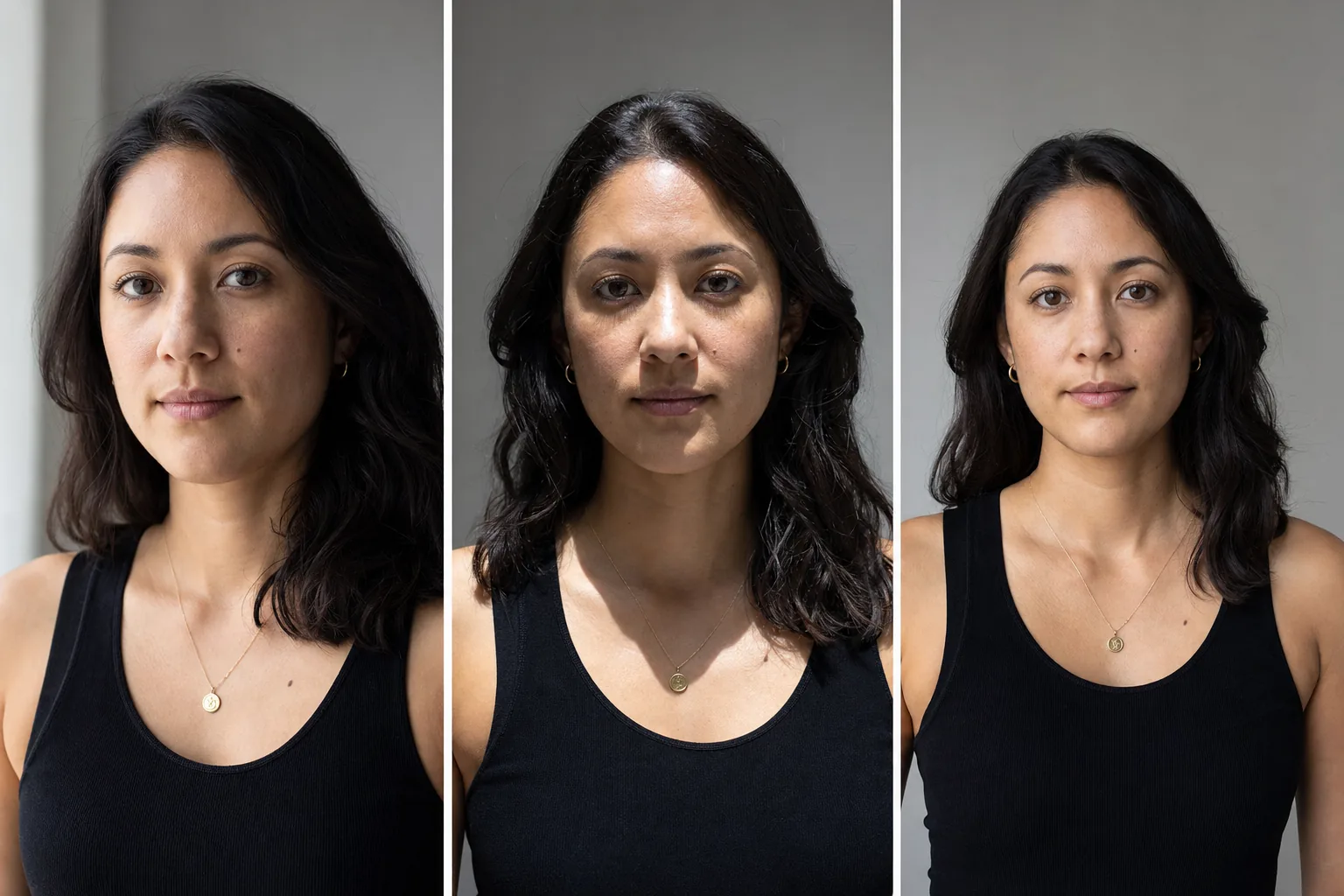
- Use neutral front-facing photos for fair comparisons.
- Check who was included and who was missing.
- Treat web image grids without methodology as illustrations, not evidence.
How to Read Average Faces Around the World
Look for the sample size, collection date, location, age range, and alignment method before drawing conclusions. If those details are absent, the safest interpretation is that the image is an editorial visualization.
Do not use a country composite to guess someone’s nationality or ethnicity. Individual faces overlap across populations, and appearance cannot verify identity.
Average Does Not Mean More or Less Attractive
Composite faces often appear smooth and symmetrical because random irregularities are averaged out. That visual smoothness can affect attractiveness judgments, but it does not prove that one population is more attractive than another.
If you want to understand the word “average” in face scoring, read our guide to average face meaning. For photo-based scoring, remember that the result reflects the image as much as the person.
Using AI Face Results Carefully
An AI face rater may compare visible patterns with its training data, but it cannot determine nationality, ancestry, health, or personal worth. Use a score as light entertainment or a photo-quality signal, not a scientific verdict.
- Try more than one neutral photo.
- Avoid comparing scores across different lighting setups.
- Never treat a composite or score as a diagnosis or identity claim.
Compare your photo under neutral conditions
Use one clear, front-facing photo and treat the result as a photo-based estimate—not an identity claim.
Try the AI face testFrequently asked questions
References and further reading
- Langlois, J. H. and Roggman, L. A. (1990), Attractive Faces Are Only Average - Psychological Science
- National Human Genome Research Institute: Race and genetics resources - Genome.gov
Related guides
Average face meaning
Understand what “average” means in face ratings and why average can still look attractive.
Read the average face guideFace symmetry test
Learn what symmetry tools measure and why natural asymmetry is common.
Explore facial symmetryLast updated: 2026-07-10
Back to the face test