Table of Contents
The phrase AI attractiveness test usually describes a photo-based tool that detects a face, extracts visual landmarks, and produces a score or written description. The useful question is not whether the model has discovered an objective beauty number. It is whether the same photo conditions are being compared fairly and whether the result helps you understand the image rather than overreact to it.
This guide separates the interactive test from the explanation around it. You will see what a model may analyze, why the result can move between photos, how to prepare a more consistent image, and which questions to ask before trusting an AI face rating. The goal is useful context, not a promise of perfect accuracy.
If you want to try a photo-based result after reading the limits, use the existing AI face rating tool with a photo you are comfortable sharing. Read the score as one signal from one image, then compare it with your own judgment and the real-world context that a model cannot see.
What an AI attractiveness test can tell you
An AI attractiveness test is best understood as an image-analysis estimate. It can identify the visible face region, measure approximate relationships between landmarks, and describe image-level cues such as balance, contrast, expression, or presentation. Those observations may help explain why one portrait feels more polished than another.
The output still depends on the input. A model sees pixels, not your personality, movement, voice, kindness, cultural context, or the way people respond to you over time. Even when the interface uses a precise-looking number, the underlying result is conditional on the photo, the training data, the model design, and the scoring scale chosen by the service.
- Useful for comparing a small set of similarly prepared photos.
- Useful for noticing visible presentation factors such as lighting, angle, expression, and framing.
- Not a clinical measurement, a universal beauty standard, or a statement about personal worth.
- Not proof that one person is more attractive in every situation than another person.
How AI analyzes a face photo
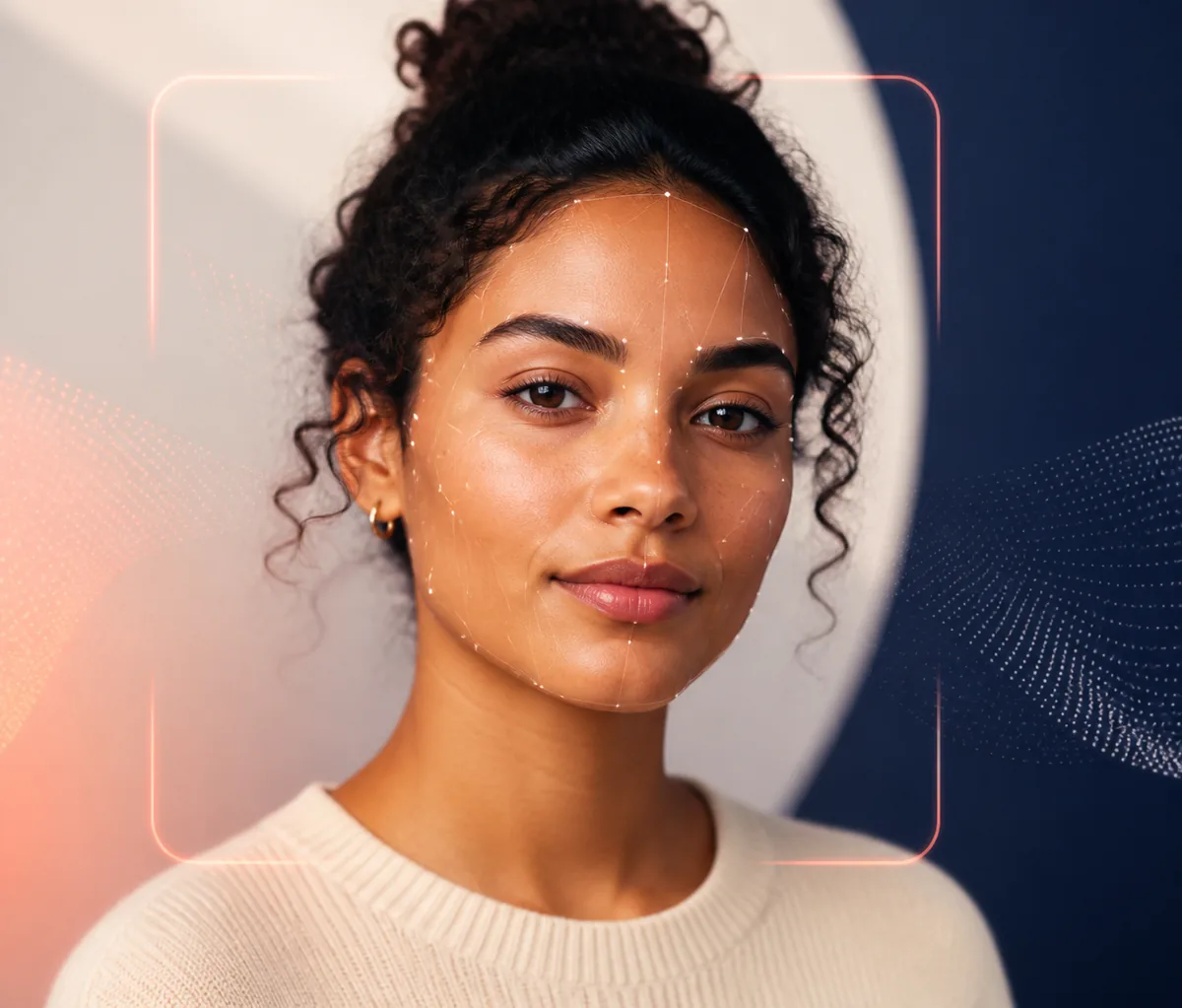
Most photo-based systems follow a pipeline rather than a single magic judgment. First, the system locates a face and checks whether enough of it is visible. It may then estimate landmarks around the eyes, nose, mouth, jaw, and face outline. A scoring layer turns those signals into a label, range, or number.
The exact formula is usually proprietary, so a page should not claim that every model uses the same weights. The table below describes common inputs that can influence a result without pretending to reveal a private model.
- 1. Face detection
The system checks whether a clear face is present and whether occlusion, blur, or cropping makes analysis unreliable. - 2. Landmark estimation
It estimates points and proportions around visible facial features, often relative to the detected face box. - 3. Image-context review
Lighting, contrast, pose, expression, camera distance, and background can change the visual signal. - 4. Result mapping
The system maps its internal features to a score, range, label, or explanation shown in the interface.
| Input signal | What it may affect | How to read it |
|---|---|---|
| Landmarks and proportions | Perceived balance in this image | An estimate, not a fixed measurement of you |
| Symmetry and alignment | How evenly features appear under this pose | Small angle changes can move the result |
| Light and contrast | Shadows, texture, and feature visibility | A harsh shadow can look like a facial difference |
| Expression and presentation | The mood and polish of the portrait | A neutral photo is not the only valid way to look |
Why the same person can get different scores
A score change does not automatically mean that the AI has discovered a hidden truth. It often means the visual evidence changed. A phone held close to the face can enlarge the center of the image; a low camera can change the apparent jawline; side light can deepen one shadow; and a smile can alter the shape of the cheeks and eyes.
This is why a fair comparison keeps the photo conditions as similar as possible. If you deliberately change the lighting, lens distance, head angle, or expression, you are testing a different image. That can be interesting, but it should not be described as a stable change in your attractiveness.
| Photo change | Likely visual effect | Fair comparison tip |
|---|---|---|
| Close phone distance | More perspective distortion | Step back and crop consistently |
| Hard side lighting | Uneven shadows and contrast | Use soft, even light facing you |
| Tilted head or camera | Different apparent proportions | Keep the camera near eye level |
| Filters or heavy retouching | Artificial texture and edges | Use an unfiltered photo |

How to take a fair photo for an AI face rating
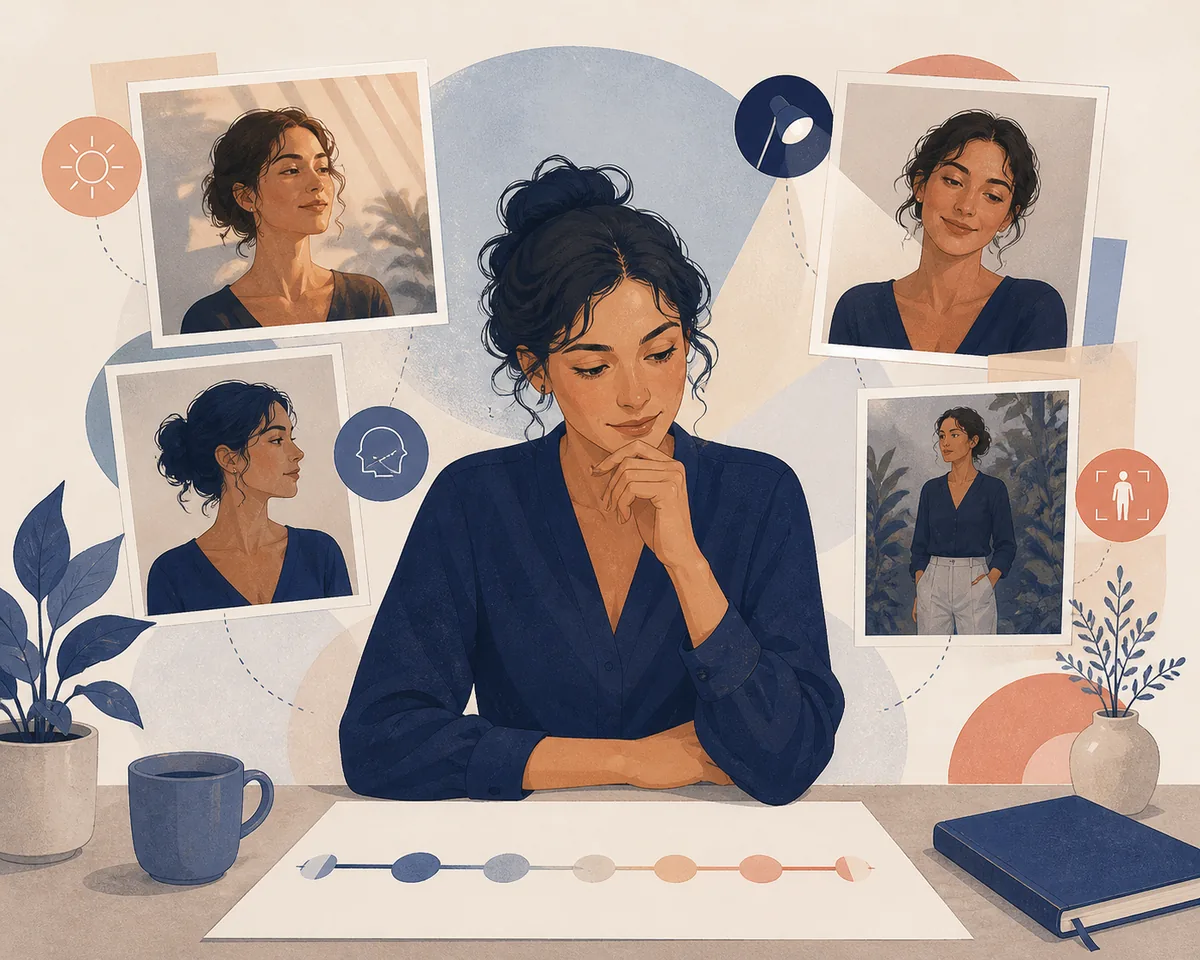
A fair photo does not mean a perfect or highly posed photo. It means the image is clear enough for the system to detect the face and consistent enough that you know what you are comparing. The simplest setup is a front-facing camera at eye level, soft light in front of you, a relaxed expression, and enough distance to avoid an extreme wide-angle close-up.
If you are comparing several photos, change one variable at a time. For example, keep the camera, crop, and light the same while testing only expression. This gives the result a more useful interpretation than uploading random selfies taken in different rooms and treating the numbers as a ranking.
- Remove sunglasses, hats, and anything that hides important landmarks.
- Keep the background simple so the face is easy to detect.
- Use the same crop and orientation when comparing results.
- Do not upload another person’s face without their permission.
Soft light
Face a window or another broad light source. Avoid a single bright lamp directly above or to one side.
Eye-level camera
Keep the lens roughly level with your eyes and leave a little space around the face.
Natural expression
Use a relaxed expression that represents the photo you actually want to understand.
No heavy filters
Filters and strong retouching change the visual input and make comparisons harder to explain.
How accurate are AI attractiveness tests?
The honest answer is conditional: an AI attractiveness test may be consistent on similar photos while still being limited as a measure of attractiveness in real life. Consistency and validity are different questions. A model can repeat its own pattern reliably without proving that its score is a universal truth.
Accuracy also depends on representation and context. Training images may not cover every age, skin tone, culture, hairstyle, camera, or expression equally. A result can therefore reflect the model’s examples and design choices as much as the individual in front of the camera.
Use an AI face rating as descriptive feedback about the submitted image. If a score changes sharply between fair photos, treat that as evidence of uncertainty and inspect the photo conditions before drawing a conclusion.
| Question | Reasonable interpretation | Do not infer |
|---|---|---|
| Is the result repeatable? | Similar inputs may produce similar outputs | That the score is objectively correct |
| Does the tool explain factors? | The feedback may help improve photo consistency | That every factor was measured scientifically |
| Does the score move? | The image signal or model confidence may have changed | That your real-world appearance changed by the same amount |
How to read an AI face rating without overreacting
Start with the photo, not the number. Ask whether the image is sharp, evenly lit, and representative of what you wanted to compare. Then look for the model’s explanation: does it mention framing, symmetry, expression, or another visible cue? A useful result should give context instead of making the number feel like a verdict.
It is also reasonable to stop testing. Repeating the same upload until a preferred score appears can turn an entertaining tool into a reassurance loop. A small, preselected set of fair photos is more informative than dozens of random retests.
- Treat the score as a photo signal, not an identity label.
- Compare like with like: similar camera, crop, lighting, and expression.
- Read the explanation and limitations before comparing decimals.
- If the result makes you feel worse repeatedly, take a break instead of testing more.
Privacy questions: does an AI attractiveness test keep photos?
Privacy is a service-policy question, not something a score can answer. Before uploading, check what the site says about processing, retention, deletion, training use, analytics, and third-party providers. A vague promise such as ‘safe’ is less useful than a clear explanation of what happens to the file and how long it remains available.
You can reduce exposure by using a photo with a plain background, cropping out documents or other people, and avoiding images you would not want processed. Never assume that an AI attractiveness test has the same retention rules as another site. The current site’s privacy policy is the right place to verify its own handling statement.
- Read the privacy policy before uploading a sensitive image.
- Crop names, addresses, school details, and unrelated people from the background.
- Use your own photo or get consent before testing someone else.
- Do not treat a third-party tool’s privacy claim as evidence about this site.
AI attractiveness test vs ChatGPT and community ratings
A dedicated AI face rating tool and a general assistant answer different questions. A face-rating tool is designed to turn a photo into a repeatable score or structured feature summary. ChatGPT is often more useful for qualitative discussion about lighting, angle, styling, or why a photo communicates a certain impression. Neither replaces real social context.
Community ratings add human reactions, but they can also be inconsistent, anonymous, appearance-focused, or unkind. If you compare sources, compare their purpose and limitations rather than asking which one has the ‘true’ number. A good workflow uses the least amount of testing needed to answer a practical question.
| Source | Useful for | Main limitation |
|---|---|---|
| Dedicated AI face rating | Consistent photo-based feedback | Sensitive to image conditions and model bias |
| ChatGPT-style discussion | Explaining visible context and photo choices | Not a standardized attractiveness scale |
| Community feedback | Hearing varied human reactions | Subjective, uneven, and sometimes unsafe |
- ChatGPT attractiveness test guide — for a closer look at qualitative AI feedback versus dedicated face raters.
- How Normal Am I accuracy guide — for a separate explanation of score uncertainty and photo conditions.
- score explanation guide — for reading score bands without treating them as fixed labels.
Want to compare one clear photo?
Use the photo-based AI face rating tool with an image you are comfortable sharing, then read the result alongside the limits in this guide.
Try the AI Face Rating ToolAI Attractiveness Test FAQ
About the author

Sarah Mitchell
Beauty tech journalist · 8+ years covering AI and aesthetics
Sarah writes about AI face analysis, beauty technology, and the limits of automated appearance scoring. Her work helps everyday users understand what a photo-based model can notice, what can distort a result, and how to use appearance feedback without turning one number into a personal verdict.
Further reading
- For a general framework on evaluating AI risks and limitations, see — NIST AI Risk Management Framework
- For an introduction to fairness questions in machine learning, see — Google Machine Learning fairness overview
Last updated: 2026-08-18
Back to the home page