What Is the Most Attractive Face Shape? Research, Style, and Context
Oval is often described as balanced, but no single face shape wins for every person, culture, photo, or style choice.

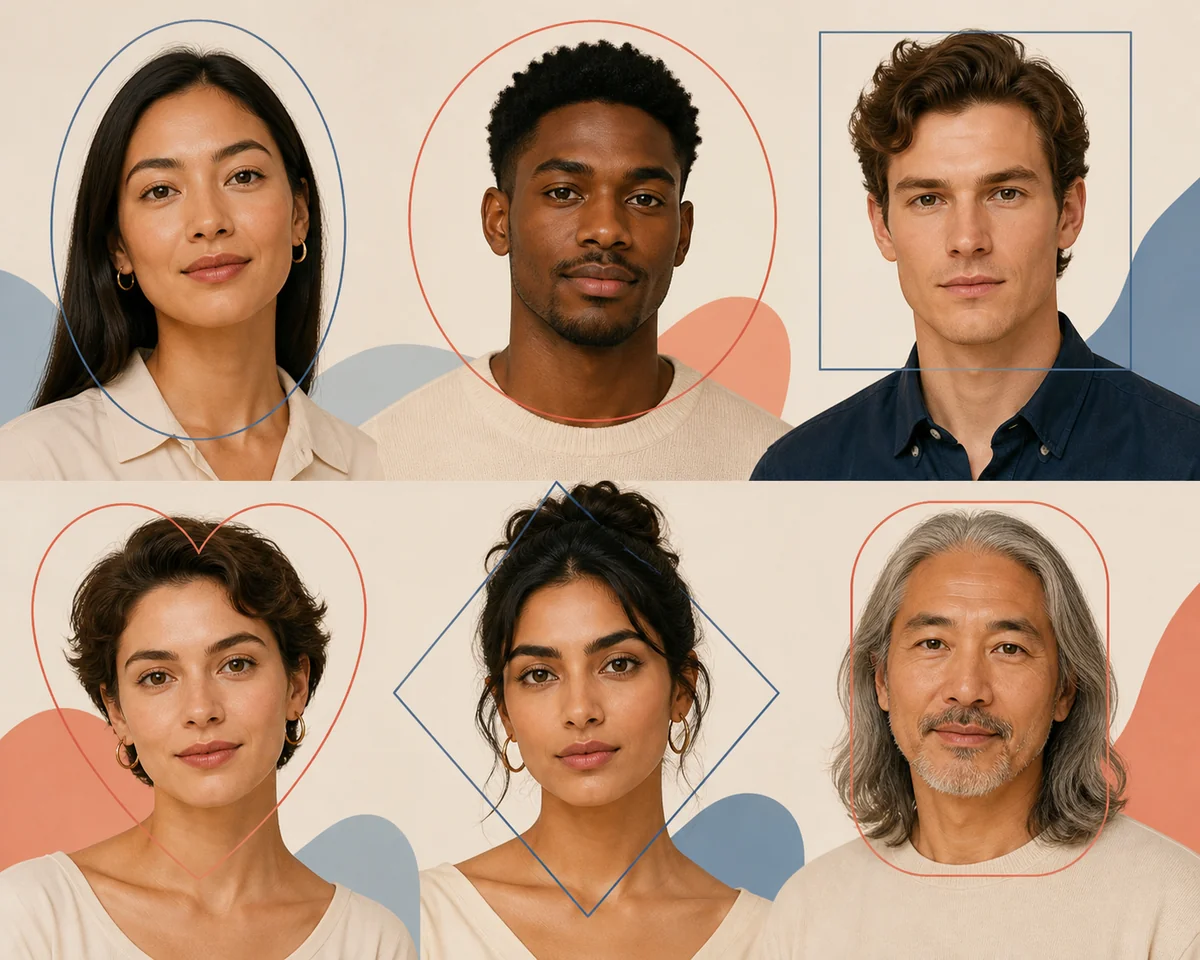
Searches for the most attractive face shape usually ask for a simple winner: oval, heart, square, diamond, or something else. The honest answer is more useful than a ranking. Face shape is an outline category, not a complete attractiveness score, and the same contour can look very different depending on proportions, expression, hair, lighting, and the person looking.
Oval is frequently described as balanced in styling articles because the face is usually longer than it is wide, with a gently rounded jaw and no single corner that dominates the outline. That makes many hairstyles and glasses easy to adapt. It does not prove that oval is the most attractive face shape for everyone, and it should not turn other shapes into problems to fix.
This guide separates four questions that are often mixed together: what research measures, what beauty culture tends to repeat, how to identify your own face shape, and how to use the result as a creative styling clue rather than a verdict.
What “Attractive Face Shape” Really Means
A face shape describes the visible outer pattern of the face: overall length, the widest area, forehead width, cheekbone width, jaw width, and whether the jawline is rounded, angular, or tapered. It is useful for choosing frames, hair volume, beard lines, makeup placement, or a consistent photo setup. It is not a diagnosis, an identity label, or a score of how good-looking you are.
When people call a shape attractive, they are usually combining several signals. A balanced outline may make features feel harmonious, but viewers also respond to feature spacing, skin and hair presentation, expression, familiarity, cultural ideals, and the way a person moves and communicates. Two faces with the same shape label can create completely different impressions.
That is why a good answer to “what is the most attractive face shape?” should explain the decision factors instead of presenting one contour as a universal ideal.
For the measurement side of the question, start with the face shape test guide
Use the label to generate options. Do not use it to decide whether your face is attractive, normal, masculine, feminine, or worth changing.
Why Oval Is Often Called Balanced
In everyday styling advice, oval is often treated as a flexible reference shape. The forehead and cheek area may be a little wider than the jaw, the face is commonly longer than it is wide, and the lower contour tends to curve rather than end in a strong corner. Those relationships give stylists many ways to add or remove visual width.
Versatility is not the same as superiority. A hairstyle that looks effortless on an oval outline may not be the best choice for someone with an oblong face and fine hair, a square face and strong curls, or a heart-shaped face with a narrow chin. Styling works best when it responds to the person’s actual proportions and texture.
The phrase “oval is ideal” also travels through beauty content because it is easy to teach. Easy to classify does not mean scientifically proven to be the most attractive face shape across countries, genders, ages, and personal tastes.
Think “versatile starting point,” not “winner.”
What Research Can—and Cannot—Say
Facial-attractiveness research rarely reduces the whole judgment to one face-shape label. Studies may measure facial width-to-height ratios, contour geometry, symmetry, averageness, sexual dimorphism, or the interaction between shape and other features. A result from one sample and one rating method is evidence about that setup, not a universal ranking of every face in real life.
Some studies find that particular facial proportions or shape categories receive higher average ratings in a given group. Other work shows that judgments shift with age, culture, expression, styling, familiarity, and the image used. Even when a paper reports an association between a shape and attractiveness, it does not mean every person with that shape will be judged attractive, or that changing the shape would improve a person’s life.
A careful interpretation is therefore: face shape can contribute to a visual impression, but it is one part of a moving system. Symmetry, averageness, proportions, and expression are related ideas, not interchangeable measurements.
For the neighboring concepts, compare the face symmetry guide · the average face guide · the conventional attractiveness guide
Face-Shape Comparison: Six Useful Starting Points
The table below is a styling map, not an attractiveness leaderboard. The “try” column gives you a direction to experiment with, while the last column marks what the label cannot tell you. Your hair texture, personal taste, cultural context, and comfort should outrank a generic rule.
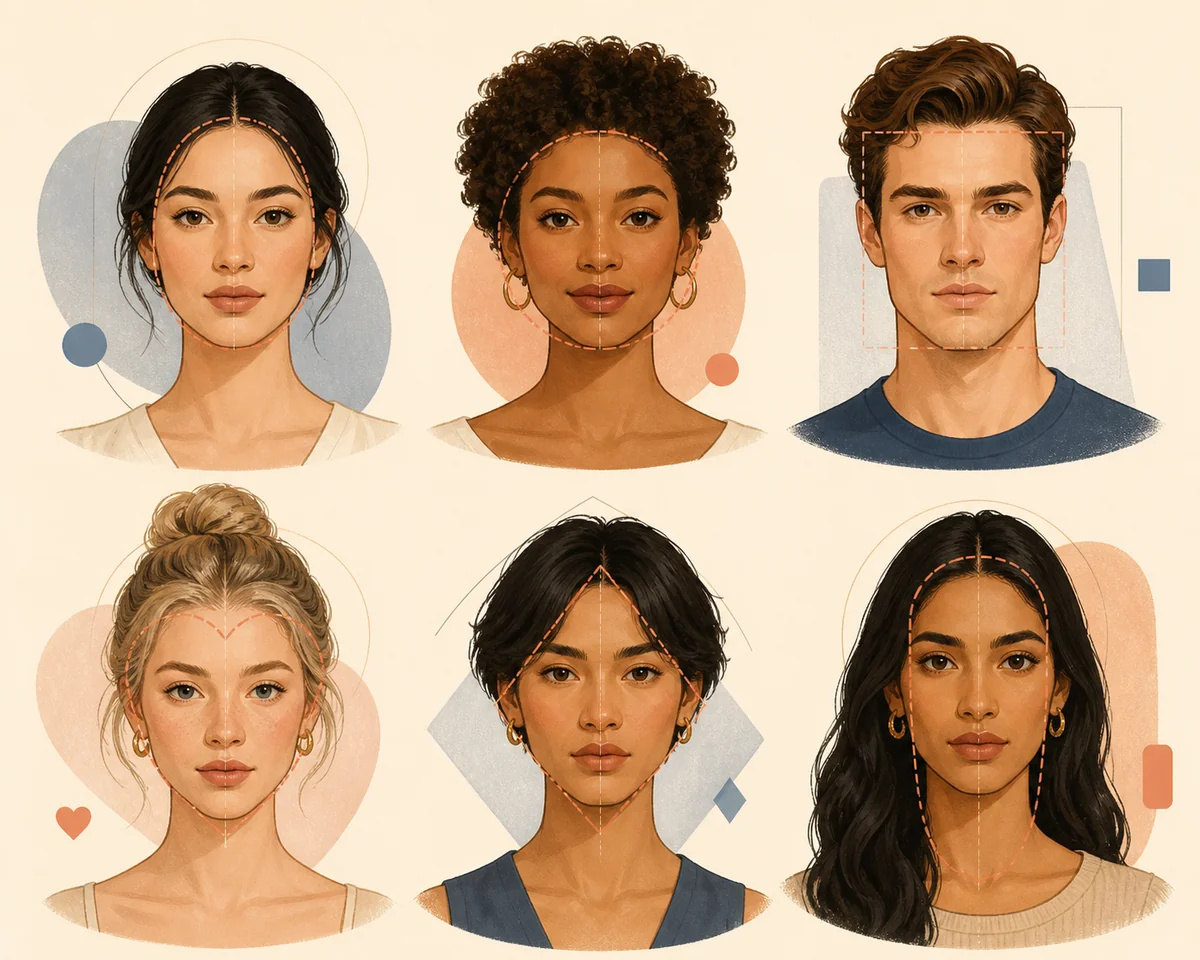
| Shape label | Common outline clues | Useful style direction | Do not infer |
|---|---|---|---|
| Oval | Length exceeds width; jaw is softly rounded | Keep balance or add texture where you enjoy it | That oval is universally most attractive |
| Round | Similar length and width; curved jaw and cheeks | Add height, movement, or angular contrast if desired | That softness is a flaw |
| Square | Strong forehead, cheek, and jaw width; angular corners | Work with structure or soften it with texture | That a strong jaw determines gender or appeal |
| Heart | Wider forehead or cheek area; narrower chin | Balance upper width with jaw-length or chin-level detail | That a narrow chin has one correct style |
| Diamond | Cheekbones stand out; forehead and jaw taper | Highlight the cheekbone structure or add gentle width | That distinctive structure is less attractive |
| Oblong | Face is noticeably longer than it is wide | Use width, layers, or fringe where it feels comfortable | That length means a photo will always look bad |
A mixed label such as “oval-square” or “round-heart” can be more honest than forcing a face into one box.
How to Find Your Face Shape Fairly
Before asking which face shape is most attractive, identify your own outline with a repeatable method. A single close selfie can exaggerate the nose, hide the jaw, or change the apparent width of the face. Hair volume and a smile can also move the outline enough to change the label.
You do not need perfect millimetre measurements. You need a consistent front-facing view and the relative order of four landmarks: face length, forehead width, cheekbone width, and jaw width. If two labels fit, keep both and use the overlap to choose more styling options.
If you want a measurement checklist, use our face shape test guide
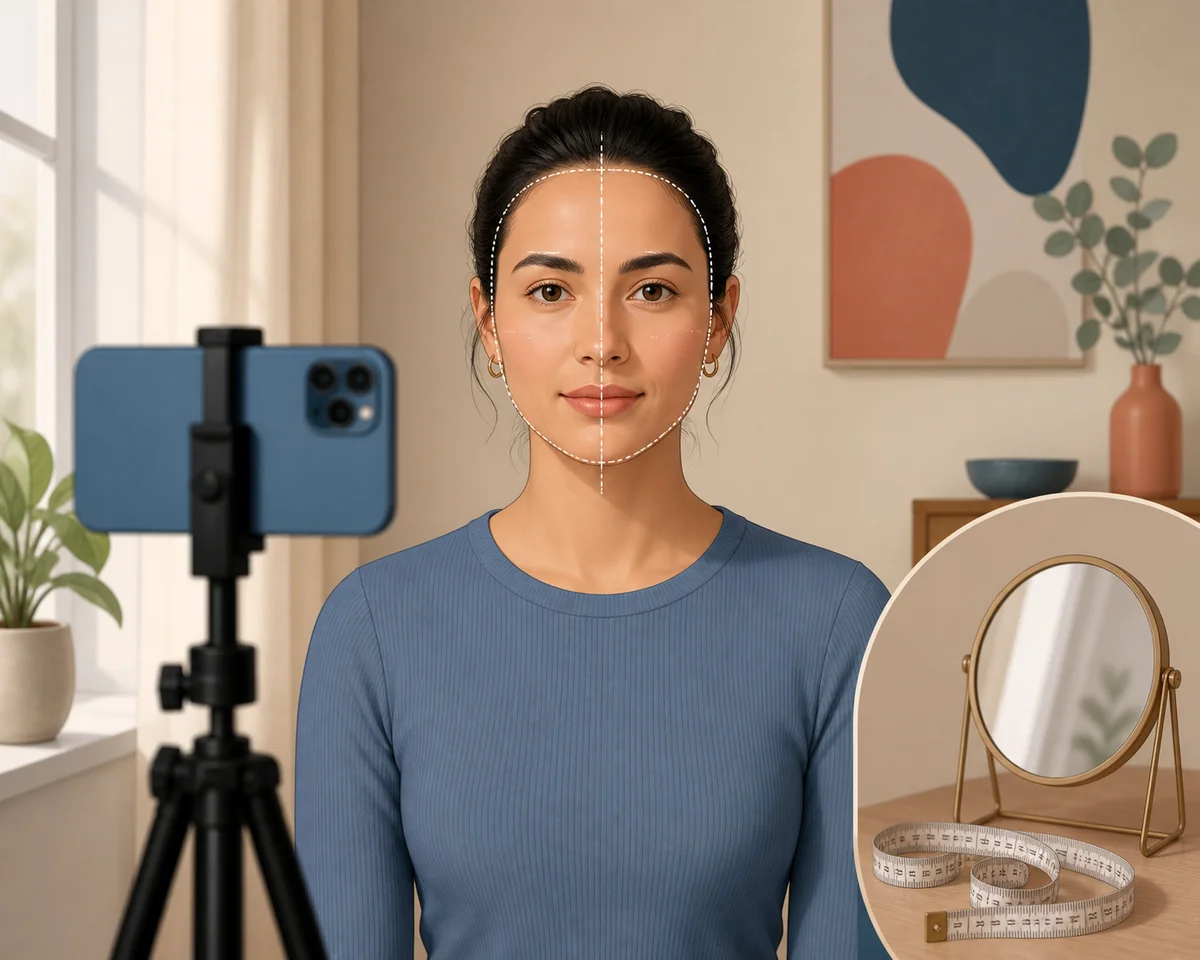
- Use a neutral photo
Face the camera at eye level, step back far enough to reduce close-lens distortion, and use soft light from in front of you. - Clear the outline
Pull hair away from the forehead and jaw, remove anything that hides the cheekbones, and relax your expression. - Compare the widest area
Decide whether the forehead, cheekbones, or jaw is widest, then compare total length with total width. - Repeat once
Check a second consistent image. If the result changes, treat the label as approximate rather than forcing a final answer.
Use Face Shape for Styling Without Rigid Rules
Face-shape advice is most helpful when it expands your choices. If you like a blunt bob with a round face, wear it. If you prefer a close crop with a heart-shaped face, that is a valid result too. The useful question is not “what am I allowed to wear?” but “what balance or emphasis do I want to try today?”
For hair, consider texture, density, growth pattern, maintenance, and how much volume you actually enjoy. For glasses, consider bridge fit, frame width, prescription, and comfort before a shape chart. For makeup or beard lines, use the face outline as a map for experimenting with light and shadow, not as a demand to hide a feature.
A good recommendation should leave room for personal taste. Face shape is a vocabulary for communicating with a stylist or trying a new reference photo; it is not a ranking of faces or a reason to compare yourself with strangers.
- Choose one feature to emphasize rather than trying to correct the whole face.
- Compare references with similar hair texture, length, and styling effort.
- Take photos in the same light when you are comparing a change.
- Keep the option that makes you feel comfortable and recognizably yourself.
Why Photos and AI Can Mislead You
An AI face tool does not see a timeless abstract face. It sees pixels from one image. Camera distance, lens perspective, head tilt, light direction, expression, hair, glasses, filters, and image compression can change the landmarks the system uses. The same person may receive different labels or scores from two photos taken minutes apart.
That matters for this topic because a face-shape detector can be helpful for vocabulary while still being wrong about the boundary. Treat the output as a second opinion. Compare it with a neutral measurement and look for a stable pattern across more than one photo.
If a result makes you anxious, repeated testing is unlikely to produce a more objective answer. Read the result as a limited description of the image, then return to the choices that actually matter: the style you want, the information you need, and how you feel in the finished look.
For photo distortion and score interpretation, read why photos can make a face feel unfamiliar · how to read an AI score
A face-shape label can describe a photo without defining the person in it.
The Bottom Line
So, what is the most attractive face shape? The best-supported answer is not a single contour. Oval is often presented as versatile because its proportions give stylists many options, but attractiveness is judged through a combination of shape, feature relationships, expression, presentation, culture, and personal preference.
Use face shape as a practical starting point: measure it fairly, keep mixed categories when they fit, try styles that respect your texture and comfort, and avoid turning a beauty convention into a scientific rule. A distinctive, square, round, heart, diamond, or oblong outline can all be balanced and attractive in the right context.
The most useful face shape is the one that helps you make better choices—not the one a ranking page declares the winner.
Want a second opinion on your face shape?
Start with a clear, front-facing photo, then compare the AI reading with your own measurements and styling goals.
Try the AI Face TestMost Attractive Face Shape FAQ
References and further reading
- Research on facial shape and attractiveness ratings; results should be read as sample-specific evidence, not a universal ranking. Read the open-access study
- Review of facial-attractiveness factors including symmetry, averageness, and proportions. Read the research review
- Recent work on how facial shape and context can influence attractiveness judgments. Read the recent study
Related guides
Face Shape Test Guide
Measure face length, forehead, cheekbones, and jawline before choosing a label.
Identify your face shapeFace Symmetry Test Guide
Learn why symmetry is only one part of facial appearance and why photos can exaggerate differences.
Read the symmetry guideConventionally Attractive Meaning
Separate social beauty conventions from personal attraction and individual style.
Understand the labelAverage Face Meaning
See why average, normal, and attractive describe different ideas.
Read the average-face guideLast updated August 10, 2026
Back to the home page