Upload a clear front-facing photo
Choose a photo where your full face is visible, the camera is reasonably level, and the lighting is even. The tool needs a readable image before it can provide useful photo-based feedback.
Upload a clear selfie to try an am I pretty test, receive an AI attractiveness score, and learn which visible photo factors influenced the result. Use it as feedback on one image, not a final judgment about you.

or drop a file, Ctrl + V to paste an image
These sample results show the type of photo-based feedback the tool can return. A score is only meaningful alongside the image conditions and explanation.
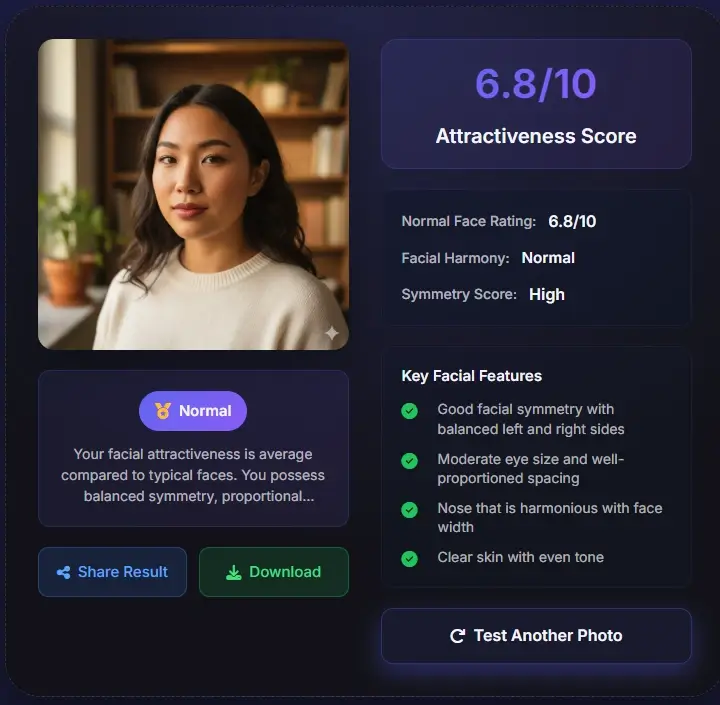
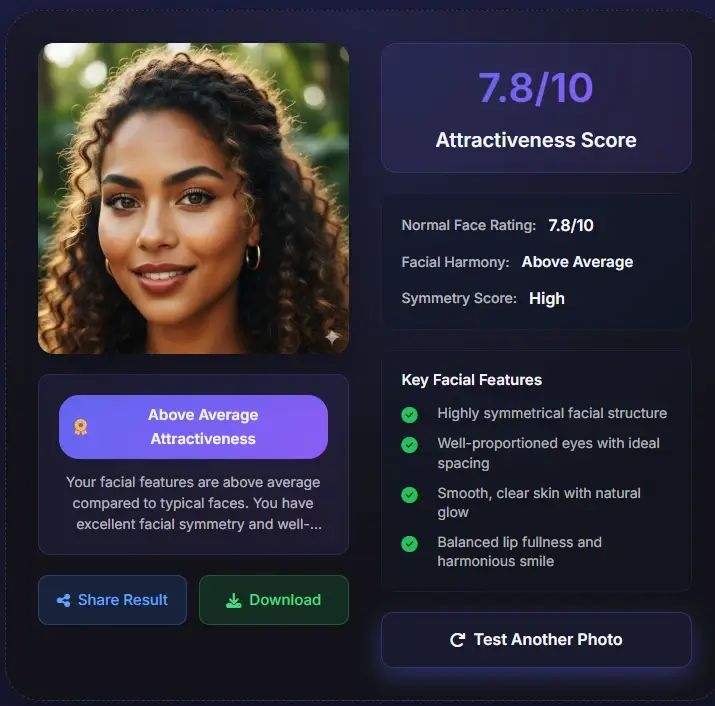

Choose a photo where your full face is visible, the camera is reasonably level, and the lighting is even. The tool needs a readable image before it can provide useful photo-based feedback.
The analysis considers visible facial balance, feature spacing, proportions, symmetry cues, and image clarity. It evaluates the uploaded picture rather than claiming to measure your complete real-world appeal.
You receive an attractiveness score, a simple rating label, and a short list of features the model noticed. Read the explanation and photo conditions before comparing one result with another.
If you want to experiment, test two or three similar photos and look at the range. A change in angle, lighting, expression, or camera distance can change the score even when the person is the same.
A number can be interesting, but it needs a clear boundary. This tool produces a photo-based attractiveness estimate, not an objective measurement of beauty.
People often search for an am I pretty test because they want a quick answer. The most responsible way to use the result is to treat it as a repeatable description of one photo. Lighting, lens distortion, expression, makeup, and the model's training data can all influence the number. A score can help you compare profile pictures or learn which conditions create a clearer image, but it cannot decide how attractive, lovable, interesting, or confident you are in real life.
A low result may reflect shadows, blur, a strong camera angle, hair covering the face, or an expression the model reads differently. Retest with a clearer and more neutral photo before drawing a conclusion.
Many photos produce middle-range results because the model is comparing visible patterns with its learned reference set. Typical does not mean unattractive, and it does not describe your personality or social appeal.
Even lighting, a readable front-facing angle, balanced proportions, and clear facial detail can support a higher result. That still means the uploaded image matched the model's preferences, not that it found a permanent truth.
If three similar photos land near one another, the range is more useful than any single decimal. If results swing widely, focus on photo quality and treat the score as highly sensitive to the input.
Understanding the input and output makes a pretty test easier to interpret and helps you spot when a result is being driven by the photo itself.
The tool works from visible information in the uploaded image. It can summarize patterns that are relatively easy for a computer vision model to compare, but it cannot see the full context that shapes human attraction. Keep the following distinction in mind when you read the result.
The model can inspect how the left and right sides appear in the photo and how the eyes, nose, mouth, and jaw are spaced. Small changes in head tilt or lens position can change that visual balance.
A face rating is not based on one isolated feature. The result reflects how several visible proportions appear together in this particular image, including feature scale and overall face shape.
A computer model can only evaluate what the camera captures. Blur, hard shadows, filters, sunglasses glare, and extreme close-ups reduce the amount of trustworthy detail available for a consistent score.
The best input is not the most glamorous photo. It is the clearest photo that shows your face without avoidable distortion.
If you are comparing two selfies, keep the conditions similar so the difference is easier to interpret. Use the same camera, distance, and general expression when possible. The goal is not to make yourself look perfect; it is to give the tool a stable image that it can read consistently.
Window light or open shade usually shows more detail than a bright ceiling light. Avoid a strong light directly behind you or deep shadows under the eyes and nose.
Hold the phone near eye level and leave a little space around your face. Very close wide-angle selfies can stretch the nose and cheeks, making comparisons less stable.
A natural expression makes it easier to compare photos. A wide smile, squint, or dramatic pose can change the visible shape of several features at once.
For a clearer reading, avoid heavy filters, sunglasses glare, strong hair shadows, very low resolution, and angles that hide part of the face.
A useful am I pretty test should be transparent about what the result means and what it cannot promise.
This page is designed for curiosity and photo comparison. The AI attractiveness score is an estimate generated from one uploaded image. It should not be used as a diagnosis, a professional evaluation, a hiring or dating decision, or evidence that one person is objectively more valuable than another. If a result makes you feel worse, stop testing and step away from the number.
A different angle, lens, expression, or lighting setup can produce a different result for the same person. That variability is a property of the input, not proof that you changed as a person.
Training data can carry cultural and demographic bias, and human ideas of attractiveness vary widely. Treat the result as directional feedback and avoid turning it into a social ranking.
Do not upload someone else's image without permission or use sensitive photos casually. Review the site's privacy policy and avoid including identifying information in an image you do not need for the test.
An am I pretty test is a photo-based tool that estimates an AI attractiveness score from a selfie. It can describe visible patterns such as facial balance, feature spacing, proportions, and image clarity, but it cannot measure your complete real-world attractiveness or personal value.
Yes. You can upload a photo and receive a free AI face rating without creating an account. The result is intended for curiosity and photo comparison, so read the limitations before treating the number as meaningful.
An am I pretty quiz usually asks questions and maps your answers to a personality-style or appearance result. This page performs a photo-based AI attractiveness analysis. The existing Am I Pretty Quiz Guide explains how to interpret quiz and pretty scale results without confusing them with an image model.
It can be useful for comparing similar photos, but it is not an objective or universal beauty measurement. Lighting, camera distance, expression, filters, occlusion, model bias, and the training reference set can all affect the output.
The model scores the image it receives. A change in head tilt, lens perspective, light, smile, blur, or hair placement can change the visible facial patterns enough to move the result. Compare a small set of similar photos rather than trusting one dramatic image.
Use a clear front-facing photo with soft, even lighting, a relaxed expression, your full face visible, and enough distance to avoid wide-angle distortion. Avoid heavy filters, sunglasses glare, strong shadows, and very low-resolution images.
No. The result is limited to visible patterns in one photo. Personality, warmth, voice, style, confidence, context, culture, and chemistry all influence human attraction and are outside the scope of this tool.