How Old Do I Look? What an AI Age Guesser Can Really Tell You
A practical guide to apparent age tests, photo quality, privacy, and why one age result should be treated as a range rather than a verdict.

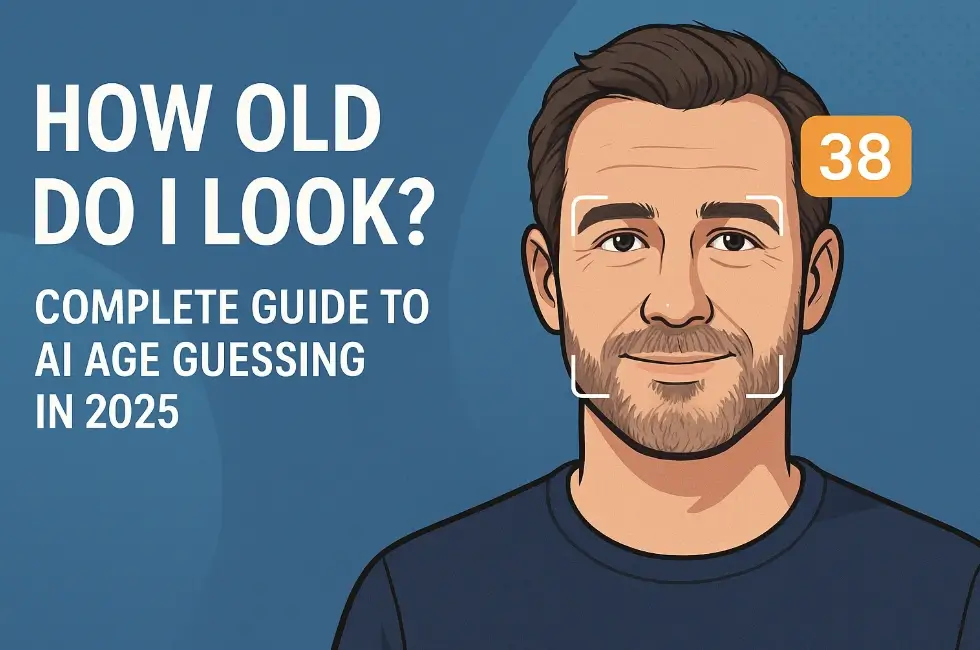
Table of Contents
People search how old do I look for different reasons. Some want a fun comparison with friends. Some want to know whether a photo makes them look younger or older. Others are testing skincare, lighting, makeup, or profile pictures.
Those goals are reasonable, but the result still needs context. An AI age guesser reads the uploaded image, not your full life, health history, or biological aging process. If the photo changes, the estimate can change with it.
This guide explains what an age guesser is actually measuring, what makes results drift, how to take a fair test photo, and how to interpret your apparent age without turning one number into a personal judgment.
What Is an AI Age Guesser?
An AI age guesser is a photo-based model that estimates apparent age by reading visible cues in an image. It looks for repeatable patterns such as facial landmarks, skin texture, contrast, shadows, feature definition, and other signs that often correlate with how old a person appears in a photo.
That makes it useful for experiments like comparing two selfies, checking whether a headshot looks polished, or understanding how lighting changes perception. It does not make it a perfect measurement of your real age or your health.
- It estimates apparent age, not biological age.
- It scores the uploaded photo, not an abstract version of your face.
- It can shift when lighting, angle, expression, makeup, or camera distance change.
- It is most useful as a comparison tool across similar photos.
Key point
A how old do I look result is best treated as a directional estimate of one image, not a permanent label.
How a How Old Do I Look Test Works
Most apparent-age tools follow the same broad process, even when the interface looks simple:
-
Face detection
The system finds the face, aligns it, and identifies landmarks such as the eyes, nose, mouth, and jawline. -
Feature reading
The model reads visible details like skin smoothness, under-eye contrast, forehead lines, facial volume, and feature clarity. -
Pattern comparison
Those signals are compared with patterns learned from large datasets of labeled images. -
Age estimate
The tool returns an apparent age or age range, often without showing how uncertain the result may be.
What Affects Age Guesser Accuracy?
Age guessers are highly sensitive to photo conditions. Small visual changes can make a face look fresher, harsher, softer, or more tired to the model.
| Factor | How it affects the result | Better testing move |
|---|---|---|
| Lighting | Harsh shadows can emphasize lines, texture, and fatigue. | Use soft daylight or even front lighting. |
| Angle | Downward or side angles can change facial definition and under-eye shadows. | Keep the camera close to eye level. |
| Camera distance | Extreme close-ups can exaggerate texture and distort proportions. | Step back slightly and crop if needed. |
| Expression | Tension, squinting, or exaggerated smiles can change how age cues appear. | Use a relaxed baseline expression first. |
| Editing and filters | Filters can smooth or sharpen features in unnatural ways. | Use an unfiltered version for the baseline test. |
If you want a fair test, hold as many conditions constant as possible. Compare similar photos instead of reading too much into one dramatic result.
Photo Tips for a Fair How Old Do I Look Result
The cleanest test setup is simple and repeatable. You are trying to show the model a neutral, readable face rather than a stylized image.
Use soft front light
Soft daylight or even front lighting reduces harsh shadows that can add years to the result.
Avoid extreme close-ups
Very close selfies can exaggerate texture and distort feature proportions.
Keep expression relaxed
A neutral or gentle expression usually gives a steadier baseline than a strained smile or dramatic pose.
Skip filters when comparing
Beauty filters, skin smoothing, and strong edits can create a number that reflects the filter more than the face.
If you want to compare styling choices, run a clean baseline first. Then change one variable at a time, such as lighting, makeup, or camera distance.
Privacy and Safety Matter More Than a Novelty Score
Age guesser tools work with face photos, which means privacy matters. Before uploading anything sensitive, check whether the tool stores images, requires an account, or explains how data is handled.
- Prefer tools that explain whether images are stored, deleted, or processed temporarily.
- Avoid uploading highly sensitive photos when the privacy policy is unclear.
- Treat apparent-age tools as optional experiments, not something you need to run repeatedly.
- If the result affects your mood more than your curiosity, step back instead of retesting.
On this site, privacy-first expectations should always be clearer than the entertainment angle. A good result is not worth careless photo handling.
How to Use Your Result Without Overreacting
Apparent age is easiest to understand when you use it for comparison, not identity. The score can tell you how a specific image reads under specific conditions.
| Question | What the tool can tell you | Best next step |
|---|---|---|
| Do I look older in this photo? | Usually yes, directionally, if you compare similar photos. | Test two or three photos with only one variable changed. |
| Is this my real age? | No. It estimates apparent age, not biological age. | Treat it as a photo read, not a health statement. |
| Why did the age change so much? | Lighting, distance, angle, texture, and editing can all shift the estimate. | Retest under steadier conditions before judging the number. |
| Can this define how youthful I am overall? | No. It only reflects one image under one set of conditions. | Use trends across photos, not one isolated result. |
Try a photo-based check
If you want to compare two or three selfies under cleaner conditions, start with the free face analysis tool and read the result as a range, not a verdict.
Test a cleaner photo setup
Upload a clear, front-facing photo and use the result as a comparison point for age, presentation, and photo quality.
Start the Free TestFrequently Asked Questions
About the Author
Sarah Mitchell
Beauty tech journalist · 8+ years covering AI and aesthetics
Sarah writes about AI face analysis, beauty technology, and the limits of automated appearance scoring. Her work focuses on helping everyday users understand what visual AI systems can measure, what they cannot measure, and how to interpret appearance results without overreacting.
References & Context
- Research overview on apparent age and face-based age estimation - Scientific Reports study
- Privacy-first expectations for handling biometric and facial data - UK GDPR guidance
- Internal guide to reading photo-based AI face scores
Last updated: 2026-06-05
Back to How Normal Am I