How Attractive Am I Photo Test: Why Ratings Change Between Photos
A practical guide to photo conditions, score drift, fair comparisons, and the limits of an AI face rating.

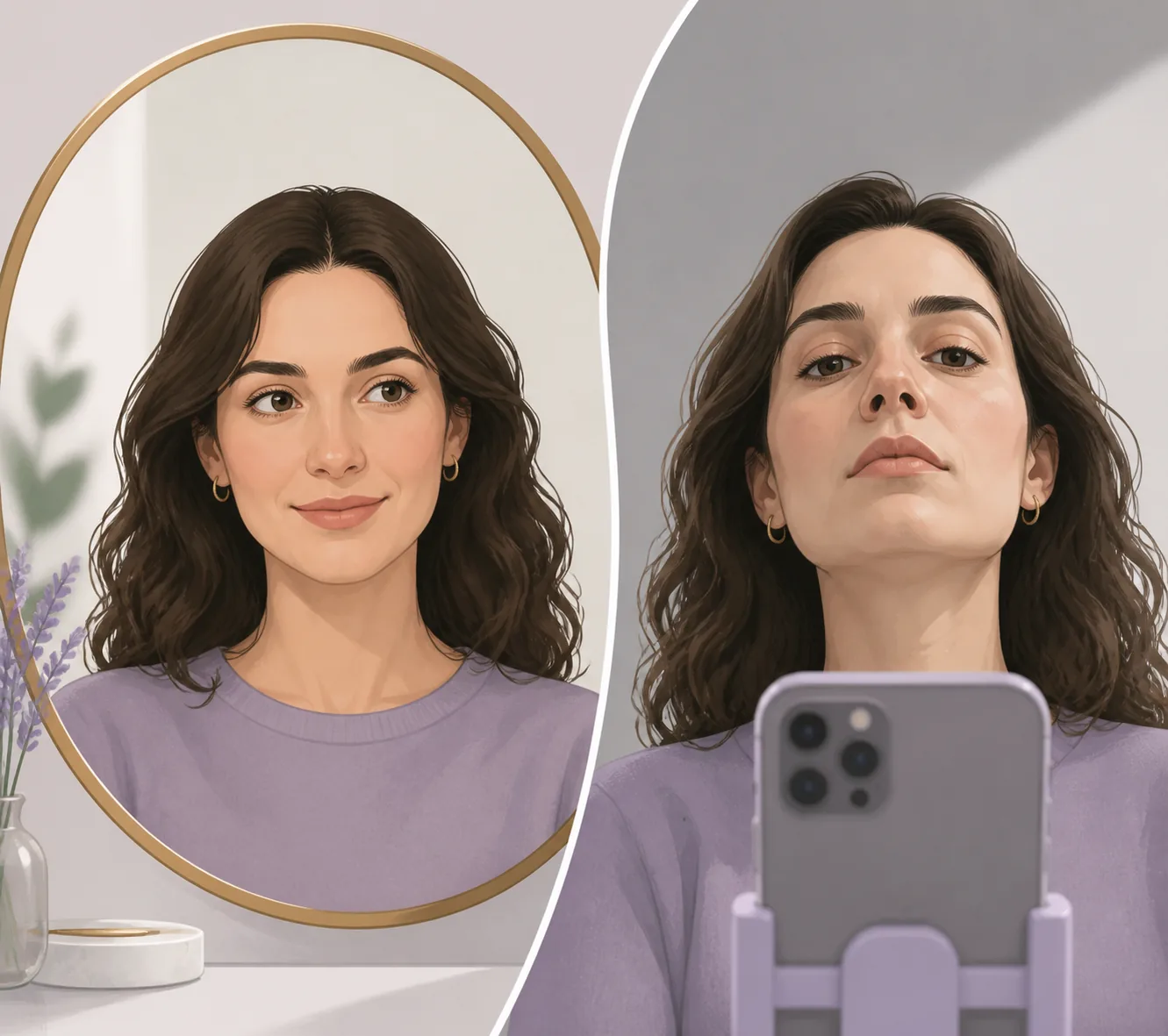
Table of Contents
A how attractive am I photo test can be confusing: one selfie receives a reassuring result and another gets a very different number. It is natural to ask which score is real or whether the model is random.
Neither photo is a complete picture of you. A face-rating system receives a crop, lens perspective, exposure, expression, and moment. It finds visible features in that frame and maps them to its own scale. Change the image and you change the evidence.
This guide explains score drift, a repeatable comparison method, and the limits of an AI face rating. The goal is useful photo feedback, not a permanent label.
Short Answer: Why Does My Face Rating Change?
A photo rating changes when the image changes visible landmarks, proportions, texture, or expression. A close selfie can enlarge the center of the face; side light can hide a cheek; a small head turn changes apparent balance. Smiling, squinting, or tensing the jaw also moves the shapes being compared.
That does not mean your face changed by the same amount. The system answers a narrower question: how does this image look under this method? Different scales and training data also make numbers from two sites non-comparable.
Best way to read the result
Use a score as a photo-condition signal. Compare two or three clear, similar images, look for a stable range and read the written explanation before reacting to the highest or lowest number.
What a Photo Rating Actually Reads
An AI face rating can be useful when the task is narrow and visible. It may detect a face, estimate landmarks around the eyes, nose, mouth, and jaw, and compare image-level patterns such as spacing or apparent balance. It can also notice whether blur, shadows, crop, or an obstruction makes the frame harder to read.
The output is still an estimate produced by a model and a chosen scale. It does not observe your movement, voice, warmth, style, or the way a familiar person responds to you over time. A model can be consistent on similar inputs without proving that its number is a universal measure of attractiveness.
| Layer | What a tool may estimate | What you should not infer |
|---|---|---|
| Image quality | Whether the face is clear, visible, and usable for the model | That a poor image proves anything about your appearance |
| Visible geometry | Approximate spacing, alignment, and proportions in the frame | That the same proportions define attractiveness everywhere |
| Model output | A score, range, label, or explanation on that service's scale | That the number transfers directly to another site |
| Repeatability | Whether similar photos return a similar pattern | That consistency makes the score a universal truth |
| Photo comparison | Which setup produces a clearer or more balanced portrait | That a higher result predicts real-life connection |
Five Variables That Move a Face Rating
The largest avoidable changes usually come from the capture setup. Keep these variables visible when you compare results:
Camera distance
A very close phone exaggerates perspective: the nose and middle may look larger while the sides recede. Step back and crop consistently.
Lighting direction
Hard side or overhead light creates shadows around the eyes, nose, cheeks, and jaw. Broad front light gives cleaner information.
Head and camera angle
A small turn, tilt, or height change alters landmark overlap and apparent symmetry. Keep the lens near eye level.
Expression
Smiling, squinting, raised brows, or a clenched jaw moves cheeks, eyes, and mouth. Compare relaxed frames with relaxed frames.
Filters and image processing
Smoothing, face slimming, portrait blur, sharpening, and compression create a different input. Turn effects off for a fair baseline.
Background, hair, glasses, crop, and focus matter too. They can hide landmarks or change contrast even when your pose is unchanged. A clear image does not need to look perfect; it only needs to show the same information from one test to the next.
Why the Same Face Gets Different Scores
Think of score drift as a three-layer problem: the subject, the capture, and the scoring system. Temporary puffiness or grooming can change presentation, the camera can change geometry, and the model can respond differently when its confidence falls. These examples show why a number can move without a sudden change in anatomy.

-
Perspective changes the proportions
A close lens does not record the same apparent spacing as a camera farther away. If the center of the face becomes prominent, a model that relies on proportions may change its estimate. -
Shadows change what is visible
Uneven light can hide one side of the nose or jaw and make the other side look sharper. The system may read contrast as a feature difference. -
Pose changes apparent symmetry
Turning or tilting the head shifts one eye, cheek, or jaw closer to the camera. Even a small pose change can alter the landmarks used for a balance comparison. -
Expression changes landmark positions
A smile lifts the cheeks, a squint narrows the eyes, and jaw tension changes the lower face. These are real changes in the image, not evidence that your resting face has been redefined. -
Resolution and compression remove detail
Blur, a low-light noisy file, or a heavily compressed upload can make edges uncertain. A model may become less stable when it cannot locate the same points confidently. -
Different tools answer different questions
One site may predict crowd ratings, another use geometric ratios, and another blend photo quality with learned preferences. Similar labels do not guarantee the same method.
How to Compare Photos Fairly
If you want to learn from a how attractive am I photo test, treat the comparison like a small, calm experiment. Start with one reference setup, then change one variable at a time.
| Step | What to do | Why it helps |
|---|---|---|
| 1 | Clean the lens and turn off beauty filters | Removes avoidable blur and artificial shape changes |
| 2 | Place the camera at eye level and step back | Reduces extreme perspective and keeps framing repeatable |
| 3 | Use soft front light and a simple background | Keeps facial edges visible without hard shadows |
| 4 | Take three relaxed, front-facing reference photos | Shows whether the tool is stable before you change anything |
| 5 | Change one variable for a second set | Lets you connect a score movement to distance, light, angle, or expression |
| 6 | Compare the range and written notes | Prevents one unusually high or low result from dominating the conclusion |
Upload the matched set together when the tool allows it, or record each result in a simple note. Look at the range and repeated explanations rather than choosing the highest score as the truth. If nearly identical photos produce a wide swing, the honest conclusion is that the result is uncertain for that input.
What the Number Cannot Tell You
An AI face rating is not a diagnosis, a social forecast, or a complete account of appearance. Keep the following limits in view:
- Do not treat one score as a permanent ranking of your face or a prediction of how every person will react.
- Do not compare scores across sites without checking the scale, the input rules, and what the service says it measures.
- Do not use a result to judge mental health, personality, desirability, or whether you are normal as a person.
- Do not keep retaking random photos until a flattering number appears. Change the setup deliberately and record what changed.
- Do not upload another person's face without permission, and read the tool's privacy explanation before sharing a personal photo.
If a result feels upsetting, pause before changing your appearance or your plans. Check whether the image was close, angled, shadowed, filtered, or blurry. A narrow photo estimate should not become a broad judgment about you.
Run a cleaner photo comparison
Use a clear, front-facing image, compare a few matched photos, and treat the result as a reference for the photo rather than a final verdict.
Start the Free TestFrequently Asked Questions
About the Author
Sarah Mitchell
Beauty tech journalist · 8+ years covering AI and aesthetics
Sarah writes about AI face analysis, beauty technology, and the limits of automated appearance scoring. Her work helps everyday users separate useful photo feedback from claims a single image cannot support.
References & Context
- Background on appearance concerns and body image - APA body image topic
- Research and evaluation context for face-analysis systems - NIST face recognition evaluation
- A broader explanation of AI appearance scores and their limits - AI Attractiveness Test Guide
Last updated: 2026-10-24
Back to How Normal Am I