Upload one clear portrait
Choose a front-facing photo with your face visible. Even light, a natural expression, and a little space around the face give the AI face rater a cleaner starting point.
Upload a clear selfie to try a face rating AI tool and get a photo-based score with feedback on symmetry, proportions, and visible facial balance.


or drop a file, Ctrl + V to paste image
These examples show the kind of photo-based output this face rating AI page is designed to return before you upload your own image.
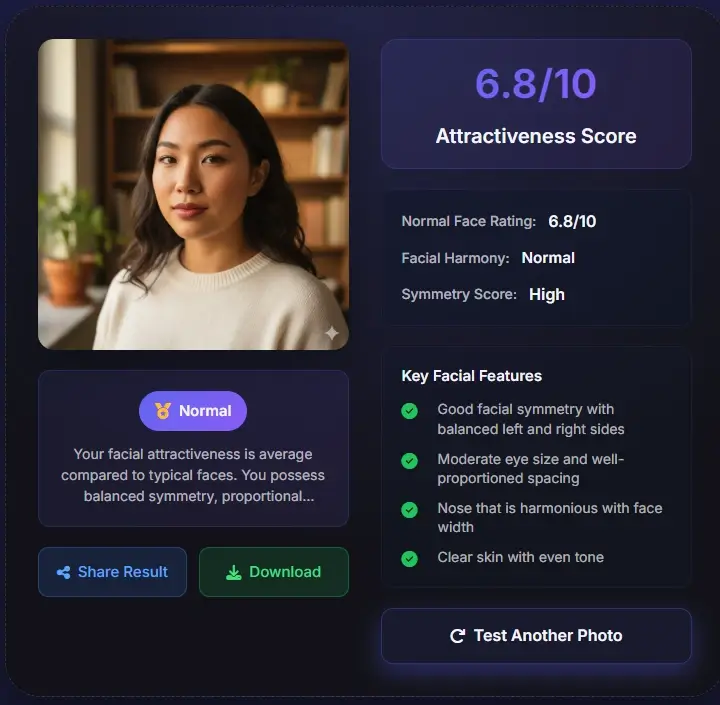
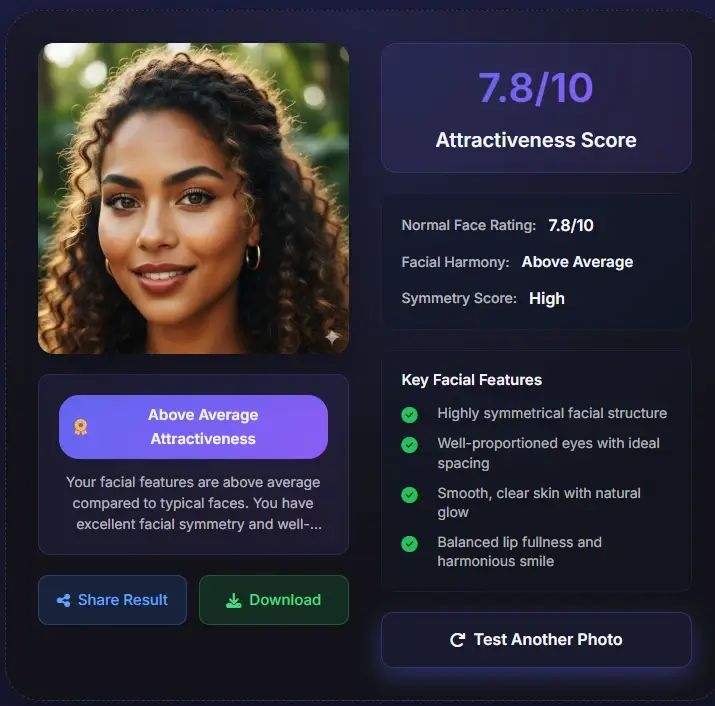

Choose a front-facing photo with your face visible. Even light, a natural expression, and a little space around the face give the AI face rater a cleaner starting point.
The system maps facial landmarks and reviews visible balance, proportions, symmetry, and image quality. It evaluates the submitted photo, not your full identity or personality.
You receive a photo-based face rating, a short label, and a summary of visible features. Compare similar photos rather than treating one number as a permanent verdict.
A score is easier to use when you know which part describes the photo and which part should not be overinterpreted.
A face rating AI result is best treated as image-based feedback. It reflects the patterns this model reads in one photo, including visible balance, clarity, proportions, and presentation. It is not a universal beauty scale.
This range often means the image quality, angle, expression, or shadows reduced the score. It does not automatically mean your real-world attractiveness is low.
A lot of people land here. It usually suggests the photo shows fairly average proportions, natural facial balance, and no major strengths or distortions pushing the rating up or down.
This is where a clear, well-shot selfie with strong facial harmony often lands. Balanced eye spacing, a proportional nose-to-face ratio, and even lighting can all support this kind of result.
Higher scores usually combine clean photo conditions with facial features the model reads as especially balanced or striking. Even here, the result should still be viewed as one image-based reading, not a permanent truth.
The practical question behind face rating AI is what the model can see in the uploaded pixels and what remains outside its view.
A face rater can only work with visible signals in the submitted image. Common signals include facial landmarks, approximate feature spacing, symmetry cues, lighting, sharpness, and pose. The exact weights are model-specific, so these are useful categories rather than a promise of a public formula.
The model may compare how balanced the visible left and right sides look and how key features sit within the detected face area.
An AI face rating usually responds to how the eyes, nose, mouth, jaw, and face outline work together in this image rather than judging one isolated feature.
Shadows, blur, filters, glasses glare, hair covering the face, and extreme angles can change the signal available to a beauty score tool.
Consistent input makes a photo comparison more useful and reduces the chance that camera conditions dominate the result.
For a fairer face rating, use a front-facing photo with soft light, a relaxed expression, and enough distance to avoid an extreme wide-angle close-up. Change one photo variable at a time when comparing results.
Natural window light or even outdoor shade works well because it keeps your features visible without adding hard shadows under the eyes, nose, or jaw.
A straight-on angle reduces distortion and gives the AI a cleaner view of symmetry, eye spacing, and overall facial proportions.
A neutral or soft expression usually gives a more consistent beauty score than a wide smile, heavy squint, or exaggerated pose, because the model is reading the geometry of the photo.
Beauty filters, sunglasses, strong hair shadows, and low-resolution uploads make the face rating less reliable because the model has less trustworthy detail to work with.
A responsible AI face rater is useful for photo feedback, but it cannot turn a visual estimate into a complete judgment about a person.
A face rating AI score can help compare profile photos or understand how image conditions affect a result. It cannot measure warmth, confidence, voice, movement, relationships, culture, or personal worth, and it may reflect model and training-data bias.
AI face rating tools are good at spotting repeatable visual patterns in photos, such as symmetry, proportions, clarity, and feature balance. That makes them useful for experimenting with selfies, profile images, or different shooting conditions.
Charm, voice, warmth, confidence, movement, styling, and cultural context all shape how attractive someone seems in person. A single AI beauty score cannot capture those qualities.
Recent research continues to question how AI systems handle attractiveness, fairness, and social bias. The safest way to use a How Attractive Am I AI tool is as directional feedback, not absolute truth.
It is a photo-analysis tool that estimates a face rating from visible patterns such as landmarks, approximate proportions, symmetry cues, lighting, expression, and framing. It reads the submitted image rather than measuring your full real-world attractiveness.
The page is designed to let you upload a photo and receive a face rating without making the interaction depend on a long setup. Availability and limits can change, so read the current page messages if the service is busy or rate-limited.
Photo handling depends on the service policy and the current processing flow. Avoid uploading an image you are not comfortable processing, crop out unrelated people or documents, and review the site's privacy policy before testing a sensitive photo.
It can be consistent on similar photos while still being limited as a measure of attractiveness in real life. Lighting, camera distance, pose, expression, filters, and model bias can all affect the result.
The model scores the pixels it receives. A different lens distance, shadow, head angle, crop, expression, blur, or occlusion changes the visual evidence and can move the rating even when the person is the same.
Use a clear front-facing portrait with even light, a relaxed expression, visible facial features, no heavy filters, and a camera distance that does not distort the center of the face.