How Accurate Is an AI Age Guesser? What Changes the Result
A practical guide to apparent-age estimates, photo quality, repeatable testing, privacy, and the limits of a number returned from one image.
On this page
People search for an AI age guesser for different reasons. You may want to compare two profile photos, check whether lighting makes you look older, or simply ask how old you look in a picture. Those are reasonable experiments, but the answer should be framed correctly: the system is estimating how a particular image is perceived, not discovering a hidden fact about your body.
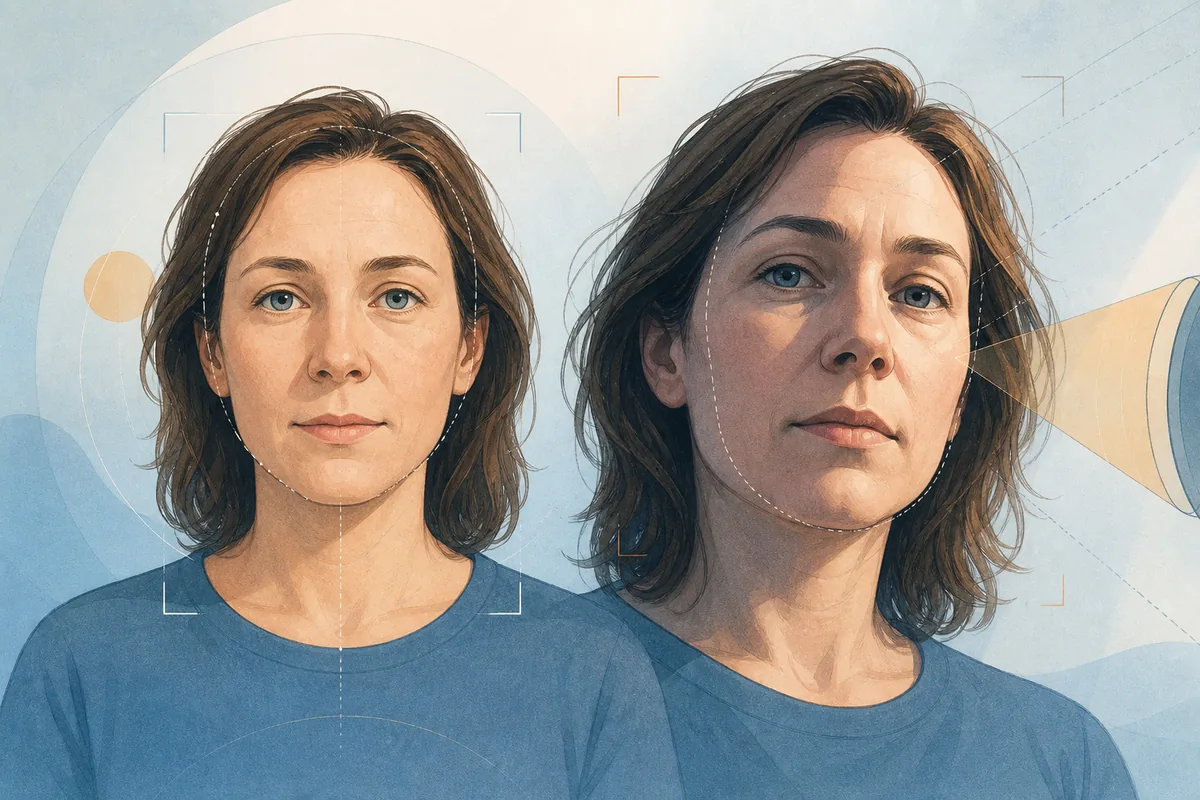
That distinction explains why the same person can receive different estimates from different photos. A shadow under the eyes, a wide-angle selfie, a tilted head, a strong expression, makeup, or a beauty filter can change the visible signals that the model uses. A changing number does not automatically mean that your real age or health changed.
This guide answers the accuracy question first, then shows how to run a cleaner comparison. It also separates useful image feedback from claims an age guesser cannot support, such as biological age, medical status, identity, or personal worth.
What an AI age guesser is actually estimating
An AI age guesser is an image-based prediction system. It detects a face, extracts visual patterns, and compares those patterns with examples learned during training. Depending on the product, the output may be a single apparent age, an age range, or a confidence label. The interface may look precise even when the underlying estimate contains uncertainty.
The model can react to visible cues such as skin texture, contrast, facial volume, hair, expression, camera perspective, and the overall presentation of the portrait. These cues are not the same as a person's chronological age. They are signals about how old the face appears under the specific conditions of the uploaded image.
- It estimates apparent age, not chronological or biological age.
- It evaluates the uploaded photo, not every context in which a person appears.
- It can be sensitive to light, angle, distance, expression, makeup, hair, and filters.
- It is most useful for comparing similar images under controlled conditions.
- Its confidence should describe the image and model fit, not your identity or health.
The key boundary
The answer to “how accurate is an AI age guesser?” depends on the task. It may be directionally useful for apparent age in a photo, while being unsuitable for proving real age, biological age, health, or attractiveness.
How accurate is an AI age guesser?
There is no single accuracy number that applies to every tool, person, photo, or age group. A model can be consistent with its own patterns and still be wrong for a particular image. Accuracy is therefore better understood as a combination of photo quality, model design, training-data coverage, and the purpose of the test.
| Factor | Why it changes the estimate | Fairer setup |
|---|---|---|
| Lighting | Hard shadows can emphasize texture, under-eye contrast, or facial hollows. | Use soft, even light from near the camera. |
| Head angle | A high, low, or side angle changes the visible jaw, brow, and cheek structure. | Keep the lens close to eye level. |
| Camera distance | A close wide-angle selfie can stretch or enlarge nearby features. | Step back slightly and crop consistently. |
| Expression | Tension, squinting, or a forced smile changes lines and shadows. | Begin with a relaxed expression. |
| Filters and retouching | Smoothing or reshaping can remove or invent signals the model reads. | Use an unedited baseline first. |
| Representation | Training examples may not cover every age, face, lighting style, or cultural presentation equally. | Treat confidence as conditional, not universal proof. |
For a casual photo comparison, a small shift may be informative: the same face looks older in one lighting setup and younger in another. For decisions that require proof of age, identity, health, or eligibility, an online age guesser is not an appropriate substitute for an official process. The result should be treated as an image-level estimate with uncertainty.
Consistency is not the same as truth
If the same tool returns a similar estimate for similar photos, that shows repeatability under those conditions. It does not prove that the model has measured your real age accurately or that its definition of “older” and “younger” is universal.
A fair method for testing an AI age guesser
You can make the comparison more useful without pretending it is a laboratory measurement. The goal is to change one variable at a time and keep the rest of the photo setup as stable as possible:
-
1. Choose a neutral baseline
Use a clear, front-facing portrait with your full face visible, no heavy filter, and enough resolution for the face to be read. -
2. Keep the camera setup stable
Use roughly the same camera distance, lens, crop, and eye-level angle for each image. Avoid comparing a close selfie with a distant portrait. -
3. Change one factor
If you are testing lighting, keep the expression and framing similar. If you are testing a hairstyle, do not also change the camera angle and filter. -
4. Run a small set, not an endless loop
Compare two to four representative photos. Repeating the same test for reassurance can make normal variation feel more important than it is. -
5. Record the conditions
Note the light, angle, distance, expression, makeup, and edits. A short note makes it easier to explain why the output moved.
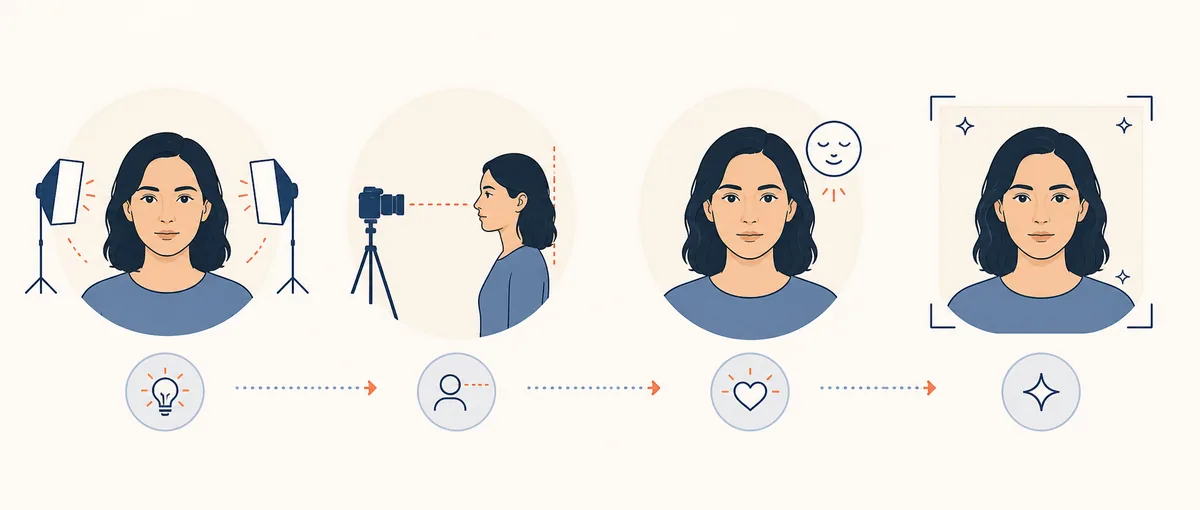
Photo conditions that change the estimate
The fairest input is not necessarily the most polished selfie. It is a photo in which the face is visible and the conditions are easy to reproduce. These practical adjustments reduce avoidable noise:
Use soft, even light
Front-facing daylight or a diffused light reduces hard shadows that can emphasize texture, hollows, or tiredness.
Avoid extreme close-ups
A wide-angle phone lens held very close can distort proportions and make the center of the face look more prominent.
Keep the camera near eye level
A steep high or low angle changes the jaw, brow, and under-eye shadows that the model can see.
Relax the expression
A neutral or natural expression gives you a steadier baseline than a forced pose or a moment of strain.
Start without filters
Smoothing, reshaping, and strong color edits may change the input more than the underlying face.
Keep the face unobstructed
Hair, sunglasses, masks, deep shadows, and heavy occlusion can reduce the model's usable facial information.
If you want to compare presentation choices, first create one unedited baseline. Then change only one feature at a time, such as lighting, hair, glasses, or makeup. That makes the comparison more interpretable and prevents you from attributing every change to age.
Privacy and limitations matter more than a curious number
An age guesser processes a face photo, so the privacy decision should come before the score. Before uploading, look for a clear explanation of storage, deletion, model training, analytics, and third-party processing. If those details are missing, treat the service as higher risk and upload only what you are comfortable sharing.
- Check whether the image is deleted after processing or retained for a stated period.
- Look for separate language about using uploads to train or improve models.
- Avoid photos that reveal children, documents, home addresses, or other sensitive context.
- Do not test another person's face without their permission.
- If a result affects your mood, pause instead of repeatedly chasing a more reassuring number.
An online estimate also has fairness limits. Training data may represent some ages, skin tones, lighting conditions, or cultural presentation styles better than others. Even when a tool appears confident, that confidence may reflect the image quality rather than equal performance across every group.
How to read the result without overinterpreting it
A useful result answers a narrow question about a photo: “Under these conditions, what age might this image suggest?” It does not answer “How old am I in every situation?” or “What does this say about my health?”
| Question | What the estimate can say | Better next step |
|---|---|---|
| Why did two photos get different ages? | The model read different light, angle, expression, distance, or editing cues. | Compare similar photos before drawing a conclusion. |
| Is the result my real age? | No. It is an image-based apparent-age estimate. | Do not use it as proof of age or health. |
| Does a high confidence score prove accuracy? | No. Confidence can describe how clearly the image fits learned patterns. | Read confidence together with photo quality and limitations. |
| What if the result makes me feel bad? | The number is optional feedback, not a personal judgment. | Stop testing and prioritize your comfort over reassurance. |
When comparing photos, focus on patterns across a small, fair set. If all of the well-lit, similar images cluster around a range, that range is more informative than the single highest or lowest output. If one image is an outlier, inspect the camera setup before making a story about yourself.
It is also reasonable for a tool to be wrong. A confident interface, a decimal number, or a neat result card does not remove uncertainty. Use the estimate as optional visual feedback, keep your own context in charge, and stop testing when the process becomes stressful rather than useful.
Try a cleaner comparison
If you want to compare a few clear portraits with broader photo-based feedback, start with the free facial analysis tool and treat every output as directional rather than definitive.
Compare photos with better context
Start with one clear, front-facing image, then use the result as a comparison point for photo quality and presentation rather than a final statement about you.
Start the free testFrequently asked questions
The practical answer
So, how accurate is an AI age guesser? It can be a reasonable tool for comparing apparent age in similar photos, especially when the face is clear and the setup is consistent. It is not a precise detector of chronological age, biological age, health, identity, or personal value.
Use a small, controlled photo set; change one variable at a time; read the output as a range; check the service's privacy practices; and stop when the experiment stops helping. That approach gets the useful part of the technology without asking one image to answer a question it cannot answer.
About the author
Sarah Mitchell
Technology and beauty journalist · 8+ years covering AI and visual technology
Sarah writes about AI face analysis, beauty technology, and the limits of automated appearance scores. Her work helps everyday users understand what an image-based system can measure, what it cannot measure, and how to interpret an output without turning it into a personal verdict.
References and context
- Research overview on apparent age and face-based age estimation - Scientific Reports study
- Guidance on privacy and personal data handling - UK GDPR guidance
- Internal guide to photo-based age estimates - How old do I look? guide
Last updated: August 22, 2026
Back to How Normal Am I